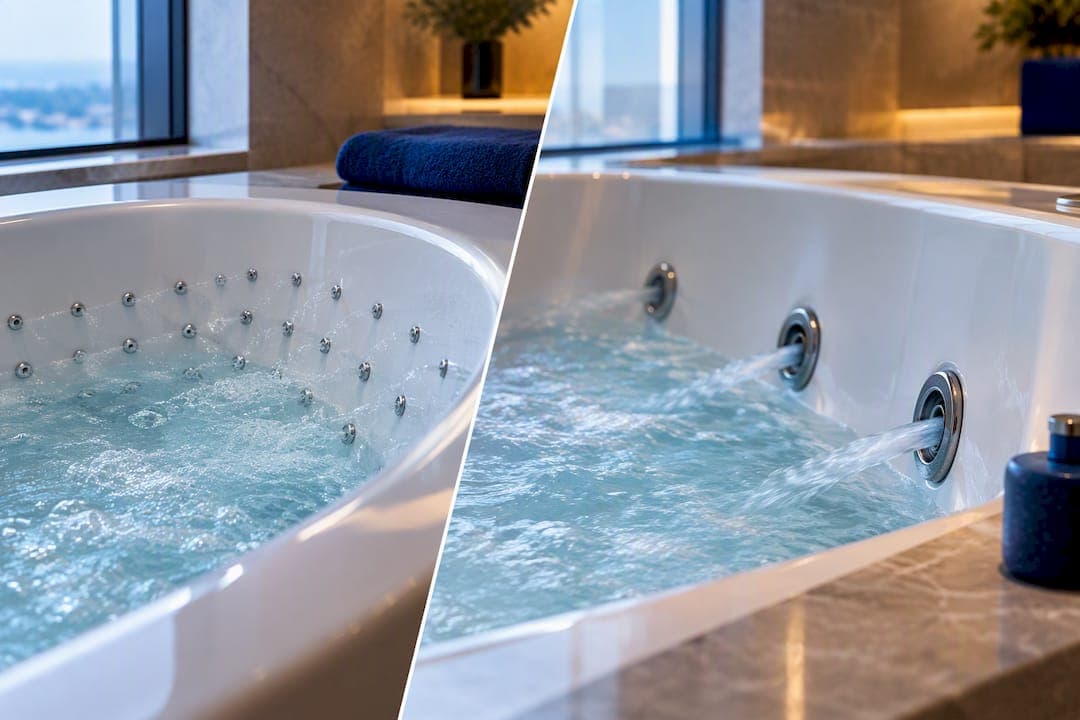
"Air tub vs jetted tub" almost always means one thing when you are booking a hotel room: does this specific room have its own private whirlpool or jacuzzi, not a shared one down the hall. The single rule that matters is this: accept the amenity only when the room listing itself, not just the hotel's general description, shows a photo or explicit wording confirming an in-room tub. Before you soak, also confirm the water temperature and cleaning routine.
TL;DR:
- Only book a room with explicit confirmation of a private whirlpool or jacuzzi through room photos or description, not just hotel-wide mentions.
- Confirm the presence of a functioning, in-room tub by requesting recent photos, reviews, and direct communication with the property before booking.
- Be aware that most hotel listings labeled "jacuzzi" or "hot tub" are often shared amenities, making verification essential to avoid disappointment.
- Understand that jetted tubs circulate water through internal plumbing, which requires regular maintenance, whereas air tubs push air through nozzles and are easier to keep hygienic.
- Verify the specific tub type—air or water jet—since jetted tubs offer stronger massage but may be noisier and less energy-efficient.
Table of Contents
- What "air tub vs jetted tub" actually means for hotel bookings
- How hotel booking data can mislead you about room amenities
- Verification checklist: 7 steps before you book a jacuzzi room
- Safety checks to run on a hotel jetted tub before you use it
- How Hotel Hot Tubs verifies in-room jacuzzis before you ever book
- Air tubs and jetted tubs: what actually separates them
- Which one delivers a better guest experience
- Cleaning routines differ between the two tub types
- Health concerns unique to each tub type
- Energy use and cost differences worth knowing
- A quick note on the mistakes travelers keep making
- Book with confidence using verified in-room listings
- Sources
- FAQ
What "air tub vs jetted tub" actually means for hotel bookings
This guide is not about residential bathtub shopping or comparing air jets to water jets for a home renovation. It is about a narrower, higher-stakes question: when a hotel listing mentions a whirlpool, jacuzzi, or jetted tub, is that tub actually inside your room, or is it a shared feature somewhere else on the property.
A room-level amenity means the specific, sellable room type you are booking includes the whirlpool or jacuzzi attribute in its own listing data. That is the gold standard. A property-level "hot tub" mention, by contrast, often describes a shared pool deck feature, a spa area, or a common hot tub available to all guests. Hotels frequently list both, and booking sites do not always make the distinction obvious.
The practical result is that two rooms at the same hotel can look identical in a search result, with one containing a private jetted tub and the other containing nothing more than a bed and a standard bathroom. Marketing copy like "jacuzzi hotel" or "whirlpool getaway" describes the property, not necessarily your room.
How hotel booking data can mislead you about room amenities
Hotel distribution systems, the software that pushes room and rate information to booking sites, generally split information into two layers: property-level data and room-level data. Property-level data covers things true of the hotel as a whole, like a pool or a shared hot tub. Room-level data covers what is inside a specific room type, like a whirlpool tub or a kitchenette.
Travelport's hotel description documentation confirms that these are treated as separate fields, and not every property fills in every field. A hotel might supply rich property-level marketing text while leaving room-level amenity fields blank, even if certain rooms genuinely have private tubs.
The same gap shows up across major platforms. Tripadvisor's developer documentation lists "Whirlpool / Jacuzzi" as a distinct room-level amenity, separate from general property amenities, which means the data structure to confirm an in-room tub exists. It just is not always populated. Meanwhile, Booking.com's hotel amenity codes include a property-level "Hot tub" code, which can describe a shared feature and proves nothing about any individual room.
Given that gap, three listing elements actually settle the question:
- The room description's own wording, not the hotel's general overview.
- Room photos that visibly show a tub inside the room, or a caption naming it as in-room.
- A room-type name or code tied directly to the sellable unit you are booking.
Verification checklist: 7 steps before you book a jacuzzi room
Run through this before you enter payment details. It takes a few minutes and prevents the most common booking disappointment: a room with a shared amenity instead of a private one.
- Look for a room-level amenity tag or explicit room description. If the whirlpool or jacuzzi is only mentioned in the hotel's overview and not in the specific room you are selecting, treat it as unconfirmed.
- Require a photo showing the tub physically inside the room. A caption that says "in-room jacuzzi" attached to that exact photo is stronger proof than a generic spa image.
- Scan recent guest reviews for mentions of private, in-room use. Reviewers often mention whether the tub was in their room or in a separate facility, and recent photos in reviews can confirm current conditions.
- Message or call the property directly with specific questions. Ask how the tub is drained and cleaned between guests, who is responsible for disinfecting it, and how often it gets checked.
- Skip listings that only advertise a property-level hot tub or spa. Without room-level proof, assume it is shared until the property confirms otherwise in writing.
- Confirm the tub is functional, not decorative, and that jets actually run. Some rooms include a jetted tub shell with jets that no longer operate, so ask directly.
- Check the cancellation and refund policy before you commit. If the amenity turns out to be missing or nonfunctional on arrival, you want a clear path to a refund or room change.
Pro Tip: Screenshot the room photo and description at the time of booking, since listings can change, and a saved screenshot gives you leverage if the room does not match what you paid for.
Safety checks to run on a hotel jetted tub before you use it
A private tub is not automatically a clean one. Whirlpool jets can trap water in internal plumbing between uses, which creates conditions for biofilm and bacterial growth if the property does not maintain the system properly.
CDC guidance on hot tub safety sets clear numeric benchmarks you can reasonably ask hotel staff about. Water should not exceed 104°F (40°C), according to the CDC, and disinfectant levels should sit at roughly 3 ppm or higher for free chlorine, or 4 to 8 ppm for bromine, with pH held around 7.0 to 7.8. The same guidance urges caution for young children and pregnant guests, who face higher risk from hot water exposure and waterborne pathogens.
Before you use a hotel's in-room tub, a few visible checks help:
- The water and tub surface look visibly clean, with no residue around the jets.
- There is little to no strong chemical smell, since an overpowering odor often signals a treatment problem rather than good hygiene.
- Any posted maximum bather load or usage instructions are followed.
- Staff can tell you whether the tub is drained and scrubbed between guest stays.
A private in-room tub still needs the same maintenance discipline as a shared one. CDC's hot tub guidance exists precisely because warm, jetted water is an easy environment for pathogens like Legionella to grow when disinfectant levels or cleaning schedules slip, whether the tub sits in a lobby spa or a honeymoon suite.
How Hotel Hot Tubs verifies in-room jacuzzis before you ever book
A specialized service lists hotels with in-room jacuzzis, tying verification back to the sellable room rather than the property's general description. That distinction is the entire point of this article, and it is built into how the site's listings are compiled.
- Listings are checked against room-level photo evidence rather than relying on a hotel's marketing overview.
- Guest feedback is sometimes considered, and travelers may report satisfaction when the tub matches the listing description.
- Readers can dig deeper into terminology and verification steps through resources like what separates a jacuzzi, whirlpool, and hot tub and a 60 to 90 second verification workflow for confirming a tub before you pay.
- The approach directly targets the risk covered in the checklist above: arriving at a hotel and discovering the tub is shared, decorative, or simply not there.
This does not replace your own judgment, but it narrows the pool of listings you have to personally vet from scratch.
Air tubs and jetted tubs: what actually separates them
Once you have confirmed a tub is genuinely in your room, it helps to know what kind you are getting. An air tub pushes air through small nozzles lining the tub's interior, producing a gentler, champagne-like bubble effect across the whole basin. A jetted tub, sometimes called a whirlpool tub, pushes water through a smaller number of larger jets, creating a stronger, more directional massage effect aimed at specific muscle groups.
The mechanical difference drives everything else. Air tubs tend to cool water more slowly since air jets do not pull water through external plumbing loops, while jetted tubs circulate water out of the tub, through a pump, and back in, which can cause faster heat loss but delivers more targeted pressure.
In a hotel context, most rooms marketed as having a "jacuzzi" or "whirlpool" tub are using water jets, since that is the more recognizable luxury feature and the term hotels use most often in room descriptions. Air tub systems show up less frequently in hotel marketing language, so if a listing specifically says "air jets" or "air bath," it is worth confirming with the property what that means for pressure and sensation, since it will feel noticeably different from the whirlpool experience most travelers expect.

Which one delivers a better guest experience
Jetted tubs generally win on massage intensity. The concentrated water jets can target the lower back, shoulders, or legs, which is why they are the more common choice for hotels marketing a "romantic" or "spa-like" room experience. The tradeoff is a stronger mechanical hum during operation and a more vigorous water movement that some guests find too aggressive.
Air tubs offer a softer, more full-body sensation, with fine bubbles rising evenly rather than concentrated streams hitting specific points. Guests who find jetted tubs too intense often prefer the air tub experience, and the quieter operation can matter in a hotel room shared with a partner trying to sleep or relax nearby.
Neither is objectively better. The right choice depends on whether you want a targeted massage or a gentler soak, and that is a preference question rather than a quality one. What matters more for hotel bookings is that both types can be marketed loosely, so confirming which system a room actually has, air or water jets, should happen alongside confirming the tub is private in the first place.

Cleaning routines differ between the two tub types
Jetted tubs pull water through internal plumbing, which means residue, soap, and skin oils can linger in the pipes between uses if the system is not flushed properly. Hotels operating jetted tubs need a cleaning routine that runs a cleaning solution through the jets themselves, not just wiping down the visible basin.
Air tubs have an advantage here since air, not water, moves through the internal lines. There is less standing water in the plumbing to harbor residue, which generally makes air tub systems simpler to keep hygienic between guests. That said, air tub nozzles can still accumulate moisture and require periodic drying or disinfecting to prevent mold or mildew inside the lines.
For a traveler, this is one more reason the operational questions in the safety checklist matter regardless of tub type. Asking a property how the tub is drained, cleaned, and inspected between guests tells you more about the hygiene you can expect than the tub's marketing name ever will.
Health concerns unique to each tub type
Jetted tubs carry a higher risk of biofilm buildup inside the water lines, since standing water combined with warmth creates conditions for bacteria, including Legionella, to grow if disinfectant levels or flushing schedules are not maintained. CDC's Legionella control guidance for hot tubs recommends disinfectant ranges and regular maintenance checks specifically because these systems recirculate water through internal plumbing.
Air tubs face a different, generally lower-severity concern: moisture trapped in the air lines can support mold or mildew growth over time if the lines are not periodically dried out. This is less commonly linked to serious illness than the bacterial risks associated with water-jet plumbing, but it can still affect air quality and cause a musty smell if neglected.
For both tub types, the practical takeaway for a traveler is the same: a strong chemical smell, visible discoloration, or a musty odor are all signs worth flagging to hotel staff before you get in, regardless of which jet system the room uses.
Energy use and cost differences worth knowing
Air tubs typically use a blower motor to push air through the nozzles, which tends to require less energy than the water pump systems in jetted tubs, since air is lighter to move than water. Jetted tubs need a stronger pump to circulate water at pressure through the jets and back into the tub, which draws more power during operation.
Water temperature retention also plays a role. Because jetted tubs cycle water out through external plumbing and back in, they can lose heat faster than air tubs, which may require the water heater or in-room system to work harder to maintain temperature during a long soak.
For hotels, this translates into modest differences in utility costs per room, though the type of tub is rarely the deciding factor in nightly room rates. For guests, it is mostly a background detail. What matters far more for your budget is confirming the room actually has the private tub advertised before you pay a premium rate for it.
A quick note on the mistakes travelers keep making
The biggest mistake I see is trusting a hotel's headline description, "jacuzzi suite" or "whirlpool getaway," without checking whether that language is attached to the actual room being booked. It usually takes less than two minutes to check the room's own photos and description, and that small step prevents a genuinely disappointing arrival.
Screenshot the room listing before you book, and if anything is unclear, message the property and ask for written confirmation that the specific room type includes a private, functional tub.
— Logan Oneal
Book with confidence using verified in-room listings
Hotel Hot Tubs built its entire directory around the exact problem this article covers: separating rooms that genuinely have a private jacuzzi from properties that only advertise one somewhere on the grounds. The searchable directory lets you filter specifically for in-room jacuzzis, and every listing is checked against photo or review evidence tied to the actual room, not just the property.
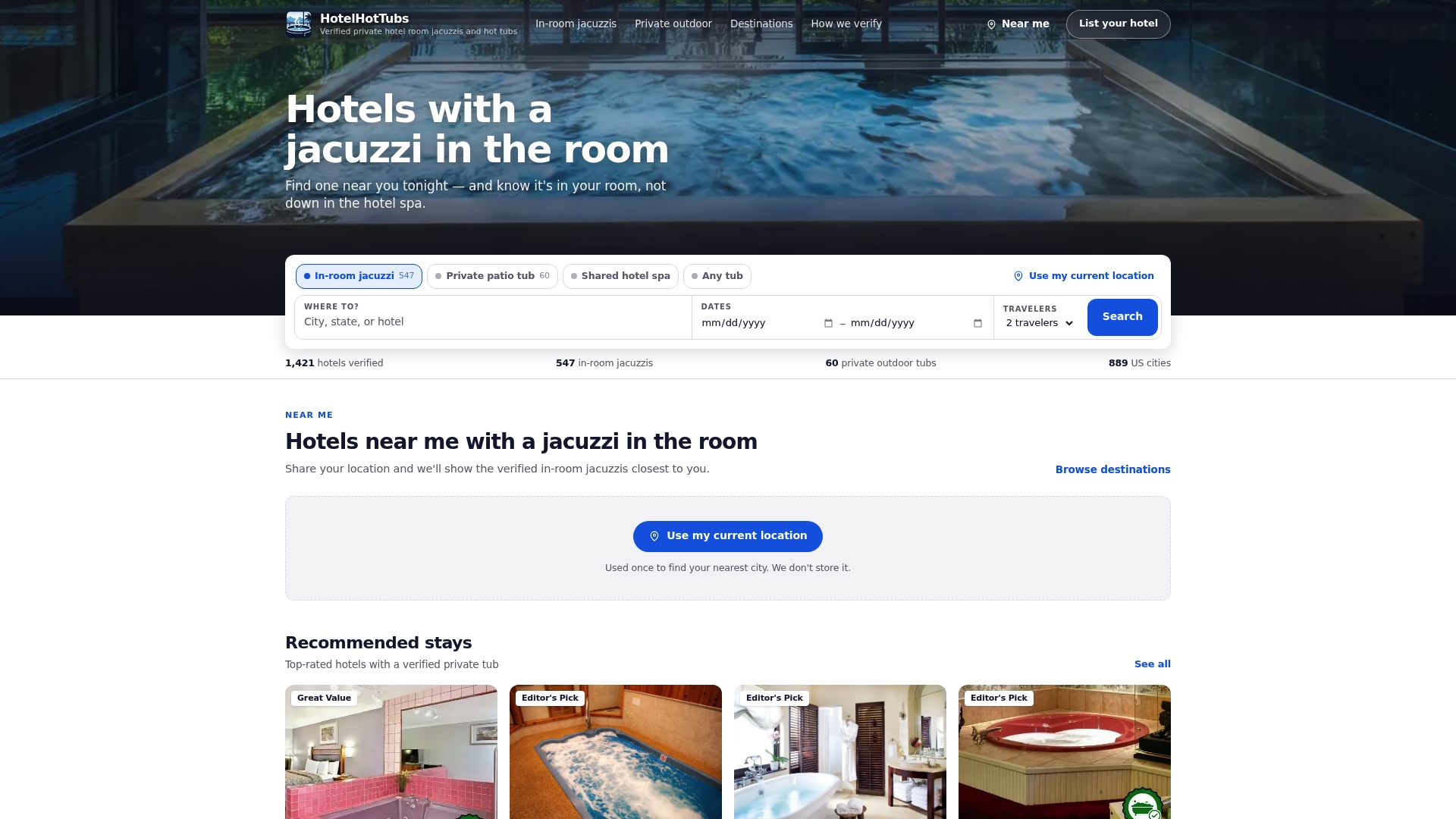
- Search by city, price, or hotel chain and filter directly for verified in-room jacuzzi rooms.
- Review the photo evidence attached to each listing before you click through.
- Follow the link to the partner booking site once you've confirmed the room matches what you want.
Start with hotels with a jacuzzi in the room to see verified listings before you book anywhere else.
Sources
This article draws on CDC hot tub safety guidance, Tripadvisor's amenity documentation, Booking.com's amenity codes, and Travelport's hotel description standards, alongside broader lodging research like this holiday home booking guide.
- Connectivity Solutions / Instant Booking API / Supported amenities | Tripadvisor Developer Portal
- (HAC) Hotel Amenity Codes (OTA 2014B) | Booking.com Developers
- QuickInfo_HotelDescription_5_0 | Travelport Support
- What You Can Do to Stay Healthy in Hot Tubs | CDC
FAQ
Is a room described as having a "jacuzzi" always private?
No. That word often describes a property-level amenity like a shared spa or pool deck hot tub rather than a tub inside your specific room. Confirm the room's own description and photos before assuming it is private.
What water temperature should a hotel jetted tub maintain?
According to CDC guidance, hot tub water should not exceed 104°F (40°C). If a tub feels hotter than that, ask staff to check it before you get in.
How do I know if a tub is an air tub or a jetted tub?
Jetted tubs use larger water jets that circulate through external plumbing for a stronger, targeted massage, while air tubs push air through small nozzles for a gentler, full-body bubble effect. Room descriptions sometimes specify which system is installed, and asking the property directly clears up any ambiguity.
What should I ask hotel staff before using an in-room tub?
Ask how the tub is drained and cleaned between guests, who handles disinfecting it, and how often it gets inspected. These operational answers tell you more about hygiene than the room's marketing name.
Does Hotel Hot Tubs verify every listing's tub type and location?
Some services tie listings to room-level photo or review evidence rather than a hotel's general property description, aligning with recommended traveler practices. You can browse verified in-room jacuzzi listings directly on the site.