
For a quiet romantic weekend without any maintenance hassle, an in-room hotel jacuzzi usually wins. For groups, families, or stays longer than a few nights, a cabin with a private outdoor hot tub tends to deliver more space and better value per person. The real trade-off comes down to three things: privacy versus who handles the upkeep, how many people you're splitting the cost with, and how certain you need to be about what you're actually booking before you arrive.
TL;DR:
- Confirm whether the tub is private to your unit and physically inside or attached to it; vague listings often describe shared access.
- For one or two travelers staying two or three nights, hotels often cost less; groups and longer stays can favor cabins after fees and taxes.
- Public tubs need twice daily testing, but private rentals may lack automated checks; ask when the water was last treated and avoid cloudy water.
- Children under five should never use hot tubs, and pregnant or immunocompromised guests should consult a doctor before entering either public or private water.
- Shared hotel tubs often close between 10 PM and midnight, while private cabin tubs are generally available throughout the stay; confirm property rules before booking.
Table of Contents
- Hot tub types and availability: what you're really booking
- Who can actually use the tub, and when
- Space, group fit, and value: when the math favors a cabin
- Maintenance, hygiene, and safety: what the guidance actually says
- Booking and verification checklist before you commit
- Natural setting versus hotel convenience: the experience itself
- What else comes with the tub: amenities worth comparing
- How the season changes your decision
- Why verification changes what you actually get
- How we help you book the right private hot tub
- FAQ
- Sources
Hot tub types and availability: what you're really booking
Not every "hot tub" listing means the same thing, and that gap causes most of the disappointment travelers report. There are three main categories worth knowing before you book.
A private cabin hot tub sits outdoors on a deck or patio, attached to the rental unit and accessible only to your group. A shared hotel hot tub is usually located near the pool, open during set hours, and used by any guest staying at the property. A private in-room or in-suite jacuzzi is built into your hotel room or suite, giving you exclusive access without ever leaving your door.
Listings don't always use these terms consistently, which is why photo evidence and specific wording matter more than marketing copy. A photo showing the tub on an enclosed deck attached to the unit is a strong signal of true privacy. Vague language like "hot tub access" or "resort amenities" often means shared use.
Before booking, check for:
- Photos showing the tub physically attached to or inside the booked unit
- Wording that specifies "private" versus "shared" or "resort" access
- Verification tags or labels confirming tub location, such as those used on hotel suites with jacuzzis in the room
- Reviews mentioning whether the tub matched the listing description
If you specifically want a private outdoor setup rather than an in-room unit, browsing hotels with a private hot tub narrows the search considerably compared to a general hotel site.
Who can actually use the tub, and when
This is where cabins and hotels diverge the most. A private cabin hot tub is yours for the length of your stay, day or night, with no one else involved. A shared hotel hot tub operates on a schedule, often closing between 10 p.m. and midnight, and may require sharing space with other guests or waiting for a free spot during busy periods. A private in-room jacuzzi splits the difference: it's exclusive like a cabin tub, but you still get hotel services like housekeeping and front-desk support.
Hotels typically post rules covering closing times, maximum occupancy, towel and robe policies, and age restrictions for the pool and spa area. These vary by property, so what's allowed at one hotel may not apply at the next.
Before you book, ask about:
- Whether the hot tub has a lockable cover restricting access outside your reservation
- Late-night or early-morning access hours for shared amenities
- Whether the property has multiple tubs on a shared deck versus one private unit
Pro Tip: If privacy matters more than price, call the property directly and ask them to confirm "in-room" or "private outdoor, not shared" in writing before you pay.
Space, group fit, and value: when the math favors a cabin
Party size and trip length change this calculation more than almost anything else. For a solo traveler or couple staying one or two nights, a hotel room with an in-room jacuzzi is often the cheaper and simpler choice, since you avoid cleaning fees and only pay for the space you need. Price comparisons across 28 US markets found hotels typically beat whole-unit rentals on all-in cost for short two to three night stays for one or two travelers.
That advantage flips for groups and longer stays. The same analysis found that whole-unit rentals and cabins more often win once a cleaning fee gets spread across more nights or more guests. A cabin that replaces three or four separate hotel rooms, each with its own nightly rate and taxes, usually comes out ahead on a per-person basis; many travelers find Smoky Mountain cabin rentals, chalet rentals & more offer exactly this kind of value and private hot tub experience.
A one-time cleaning fee is the detail that trips people up. For a two-night stay, that flat fee gets divided across only two nights, which can erase any savings versus a hotel. Pricing comparisons note that a one-time cleaning fee makes whole-unit rentals less economical for short stays, and recommend comparing the final checkout total rather than the advertised nightly rate.
A few scenarios illustrate the pattern:
- A couple booking two nights: an in-room hotel jacuzzi suite often costs less once resort fees and a cabin's cleaning fee are both factored in.
- A group of six booking four nights: a cabin with one private hot tub usually beats renting two or three hotel rooms, even after the cleaning fee.
- A family staying a full week: the cabin's cleaning fee becomes a small fraction of the total cost, while a hotel's nightly rate keeps accumulating.
Always add the nightly rate, resort or cleaning fees, and taxes before comparing options side by side.
Maintenance, hygiene, and safety: what the guidance actually says
Public and private hot tubs are not held to the same standard, and that difference matters for your health. For public facilities like hotel hot tubs, the CDC recommends free chlorine levels of 3 to 10 parts per million or bromine of 4 to 8 parts per million, with pH kept between roughly 7.0 and 7.8 and testing at least twice daily. Many public facilities use automated dosing systems to maintain these levels consistently.
Private rental hot tubs generally aren't subject to the same automated monitoring or testing frequency, and compliance depends entirely on the owner. This gap has real consequences: outbreak investigations have linked improperly maintained private-use hot tubs in vacation rentals to Legionnaires' disease, a lung infection caused by inhaling contaminated water vapor. Legionella bacteria thrive in warm, poorly circulated water, which makes consistent maintenance critical for any tub, public or private.
Before using either type, check for:
- Cloudy or discolored water, a sign sanitizer levels may be off
- A strong chemical smell, which often signals that disinfectant has reacted with contaminants rather than that the water is extra clean
- Asking the host or front desk when the tub was last shocked or drained
The CDC also recommends showering before entering, never swallowing the water, and keeping children under age 5 out of hot tubs entirely. Pregnant guests and anyone who is immunocompromised should talk to a doctor before using any hot tub, public or private, given the elevated risk from waterborne bacteria.
Booking and verification checklist before you commit
A short conversation before you pay can prevent most hot tub disappointments. Whether you're messaging a cabin host or calling a hotel front desk, a few direct questions clear up the ambiguity that review sites often leave behind.
Ask or confirm:
- Is the tub private and exclusive to my unit, or shared with other guests?
- Is it indoors, in-suite, or on an outdoor deck attached to the unit?
- When was it last shocked, drained, or professionally cleaned?
- Does the property use automated chemical dosing, or manual testing on a schedule?
- What's the maximum occupancy, and are there posted hours or rules?
A simple message like "Can you confirm the hot tub is private to our unit and not shared with other guests or units on the property?" usually gets a straight answer fast. For hotels, our own 60-second jacuzzi check walks through what to look for at check-in.
Pro Tip: If a host or front-desk agent can't answer how recently the tub was cleaned, treat that as a red flag, not an oversight.
Red flags worth acting on include cloudy water, no answer on maintenance timing, or listing photos that don't match what you see on arrival. Any of these justifies asking for a different room or rebooking elsewhere.
Natural setting versus hotel convenience: the experience itself
Beyond logistics, the two options simply feel different. A cabin hot tub usually sits outdoors, surrounded by trees, mountains, or quiet, with nothing but ambient sound and open sky overhead. That setting is a large part of why people choose a cabin in the first place. It trades convenience for atmosphere: no front desk, no scheduled hours, just a private deck and whatever the season brings.
A hotel jacuzzi, by contrast, is built into urban or suburban convenience. You get climate control, immediate housekeeping, and the ability to step from the tub straight into a made bed without walking outside. For travelers who want a polished, low-effort evening after a day of meetings or sightseeing, that indoor privacy without the outdoor variables can feel like the better fit.
Neither experience is inherently better. A cabin trades hotel services for seclusion and scenery, while a hotel trades scenery for consistency and staff support. The choice usually comes down to what you're trying to unplug from: a cabin answers a need for quiet and distance, while a hotel answers a need for ease and reliability. Travelers chasing a once-a-year escape tend to lean toward the cabin's atmosphere, while those stacking a hot tub onto a business trip or city visit often prefer the hotel's simplicity.

What else comes with the tub: amenities worth comparing
The hot tub rarely stands alone, and the amenities built around it often shape the whole stay. Cabins commonly pair a private tub with a fire pit, a covered porch or outdoor seating area, and sometimes a grill, letting a group spread out across multiple outdoor spaces instead of competing for one.
Hotels take a different approach, usually bundling the tub into a broader package of on-site services: a fitness center, room service, sometimes a spa offering massages or facials, and an indoor pool. Properties that combine an indoor pool with an in-room tub, like those listed under hotels with an indoor pool and a hot tub in the room, appeal to travelers who want more than one way to relax without leaving the building.
For a romantic weekend, an in-suite whirlpool paired with turndown service or room service champagne often does more to set the mood than a fire pit would. For a family or group trip, a fire pit and multiple outdoor seating areas tend to get more use than a single hotel spa appointment ever could. Matching the amenity bundle to how your group actually spends its downtime matters more than chasing the longest amenities list.
How the season changes your decision
Weather affects a cabin's outdoor hot tub far more than it affects a hotel's indoor or in-suite jacuzzi. A snowy winter evening can actually make an outdoor cabin tub more appealing, with steam rising against cold air, but heavy storms, extreme cold, or wildfire smoke in some regions can limit comfortable use or even close access to the deck entirely.
Hotel jacuzzis, especially indoor units, stay usable regardless of what's happening outside. That consistency makes hotels a safer bet for trips planned during unpredictable weather windows, like early spring or hurricane season in some coastal areas.
Road access to remote cabins can also become a factor in winter, when snow or ice affects driveways and mountain roads leading to the property. Hotels, typically located closer to maintained roads and plowed lots, remove that uncertainty. If you're booking a winter mountain getaway specifically for the cabin experience, ask about road conditions and whether the outdoor tub stays operational through the coldest months before you commit.
Why verification changes what you actually get
We built our listings around one idea: the biggest source of hot tub disappointment is ambiguity, not availability. Certain directories verify listings down to where the tub sits, in-room, private outdoor, or shared, backed by photo or review evidence rather than marketing language alone.
That verification step exists because "hot tub included" can mean wildly different things depending on who's writing the listing. Travelers sometimes assume a shared pool-deck tub was private simply because the word "private" appeared somewhere on the page. Labeling the tub's exact location removes that guesswork before a guest ever checks in, which means fewer surprises on arrival and a much clearer set of expectations going in.
— Logan Oneal
How we help you book the right private hot tub
We built our directory specifically for travelers who want a verified private or in-room jacuzzi, not a shared pool-deck tub they stumble into after booking. Every listing is labeled by tub location and backed by photo evidence, so you know exactly what you're getting before you pay.
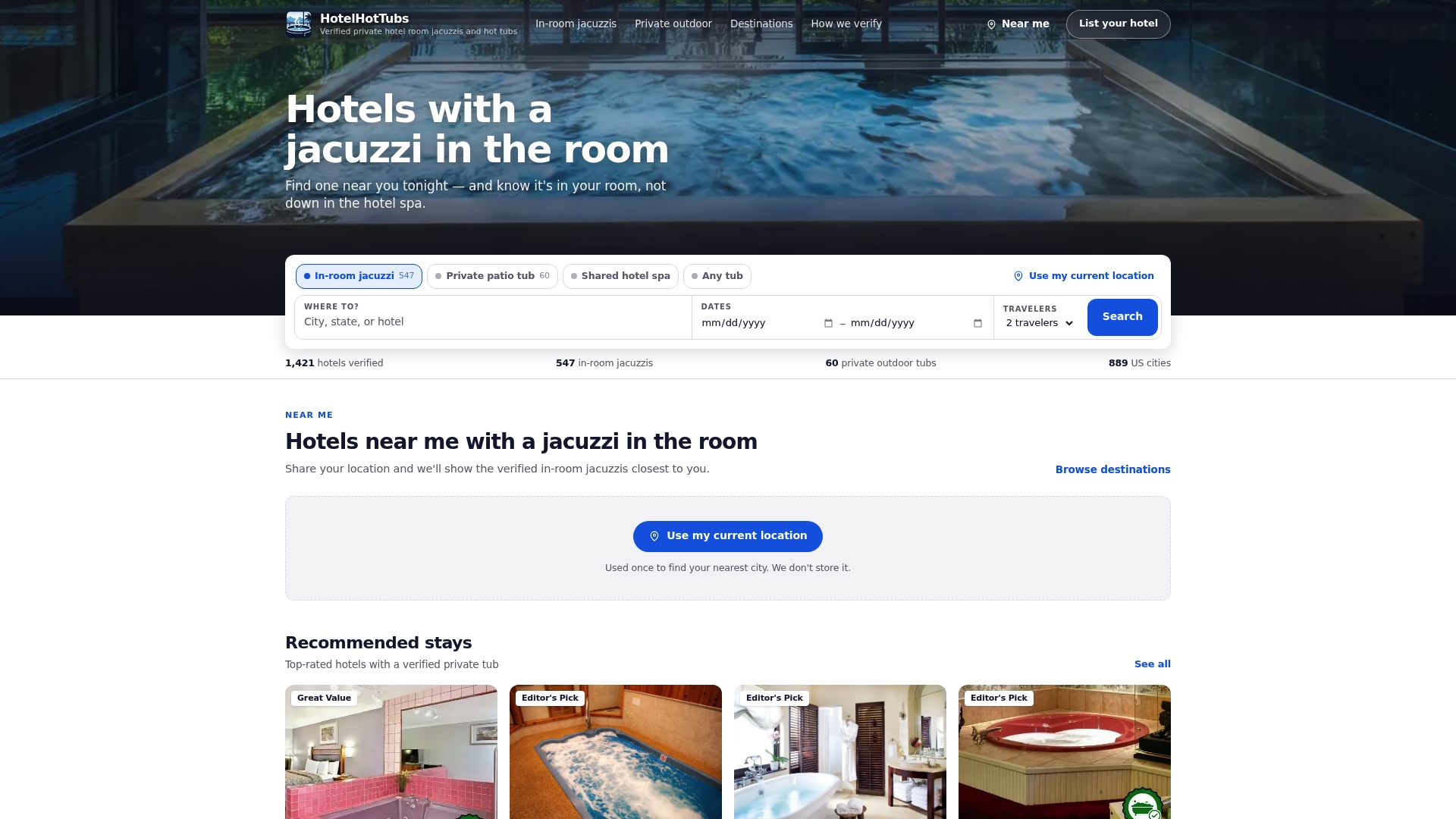
That verification matters most for short romantic trips, where a shared hot tub can quietly ruin the plan. Browse hotels with a jacuzzi in the room to filter by location, price, and verified amenity photos, and book a stay where the privacy you expect is confirmed before you arrive.
This article is general information, not a substitute for advice from a qualified doctor. Consult a qualified healthcare professional about your own circumstances before acting on anything here.
FAQ
Is it cheaper to stay in a hotel or a cabin rental for a week?
For a full week, a cabin or whole-unit rental is usually more economical per person, since the cleaning fee gets spread across more nights and the space often replaces multiple hotel rooms. Hotels tend to win for shorter one to two night stays where that fee has less time to average out.
Can you sleep in a cabin overnight like a hotel room?
Yes, cabins are designed for overnight stays and typically include bedrooms, bathrooms, and a kitchen, functioning much like a house rental rather than a single hotel room. Many cabins sleep multiple guests across several bedrooms, which is part of why they suit groups and families well.
Why do some hotels no longer offer public hot tubs?
Some hotels have removed shared pool-deck hot tubs due to the ongoing maintenance demands of meeting public health standards, including frequent disinfectant and pH testing recommended by the CDC. Many have shifted toward private in-room jacuzzi suites instead, which simplifies upkeep and appeals to guests who prioritize privacy.
Are a lodge and a cabin the same type of accommodation?
Not exactly. A cabin is typically a smaller, standalone unit meant for one group, while a lodge is often a larger building with multiple rooms or units, sometimes resembling a small hotel with shared common areas.
Sources
- Controlling Legionella in Hot Tubs | Control Legionella | CDC
- Airbnb vs Hotel 2026: All-In Price Math Across 28 US Markets | AirROI
- Hotel Vs Airbnb Cost In The USA (2026) | Which Is Cheaper?