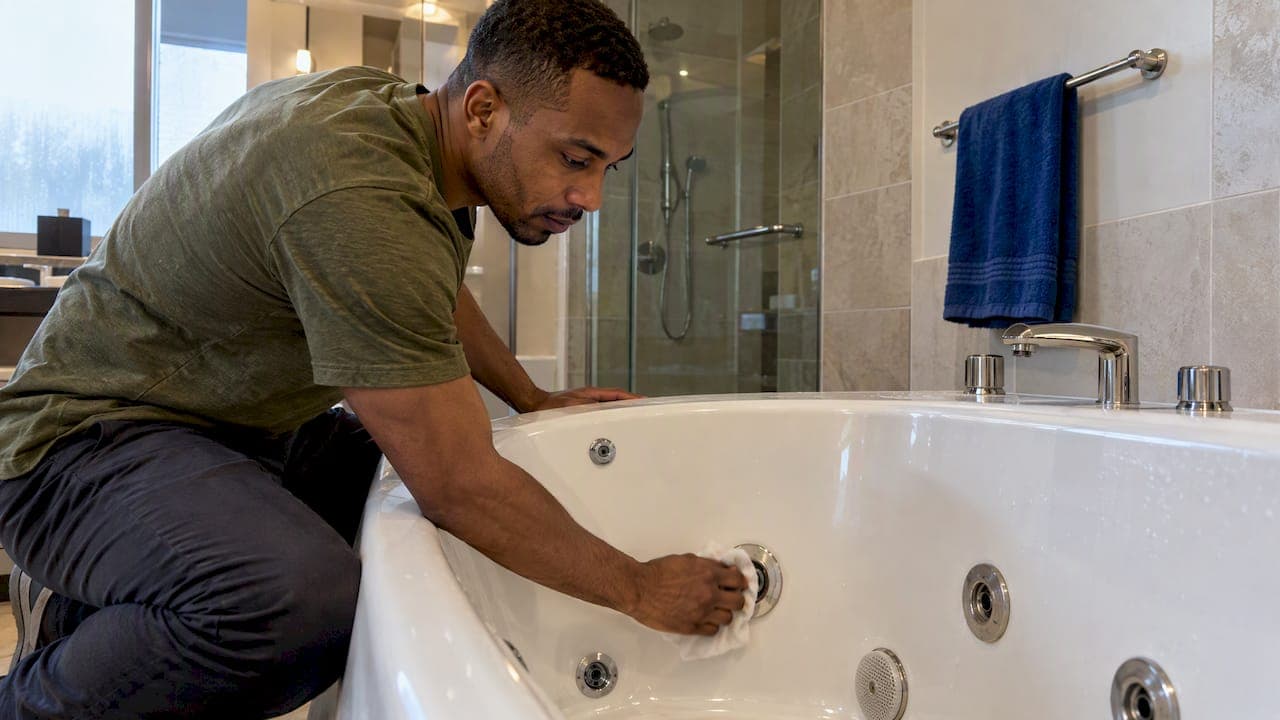
You can make a hotel jetted tub much safer in about 15 minutes: inspect it, rinse it, fill it above the jets with warm water, run the jets for 5 to 10 minutes, then drain and rinse. That is the routine Wisconsin's health officials describe when no manufacturer instructions are available. If the tub shows slime, dark flecks or a musty smell, skip it and tell the front desk. A guest is not the right person to chemically disinfect a tub they do not own.
This guide covers what to look for, what you can do yourself, what you should leave to staff and how to book a room where the tub is more likely to be well kept.
TL;DR
- Jetted tubs hold stagnant water in their plumbing, so biofilm and bacteria such as Legionella can grow between guests.
- A guest flush is simple: warm water above the jets, jets on for 5 to 10 minutes, then drain and rinse.
- Never mix a detergent with a sanitizer, and never mix chemicals in general.
- Brown or black flecks, slime or a sour smell mean you should stop and ask for another room or a staff-run cleaning.
- Check the tub's condition and ask about cleaning before you book, not after you arrive.
Table of Contents
- Are hotel jetted tubs sanitary?
- A 60-second inspection before you do anything
- How to clean a hotel jetted tub as a guest
- What is the brown or black stuff in the jets?
- Cleaning versus sanitizing: they are different jobs
- Can you put Dawn dish soap in a hotel jetted tub?
- Check water quality if the tub is a true hot tub
- What to ask the hotel before you book
- Our perspective on hotel tub hygiene
- Find a room with a verified in-room tub
- Quick checklist for your next stay
- FAQ
- Sources
Are hotel jetted tubs sanitary?
They can be, but they need more care than a flat-bottomed bathtub. A jetted tub is a fill-and-drain system: water sits in pipes and jet housings after the tub empties. According to the Wisconsin Department of Agriculture, Trade and Consumer Protection, jetted fill-and-drain tubs carry higher health risks because that stagnant water allows biofilms and bacteria, including Legionella, to grow. The same fact sheet notes that when the jets run, the water is aerosolized, which can expose the next person to whatever is in the lines.

A county guide from Douglas County, Wisconsin lists what accumulates in jets, drains and hose lines: soap scum, oils, urine, fecal matter and bacteria such as Pseudomonas aeruginosa and Legionella. That is not pleasant to read, and it is also not a reason to avoid every in-room tub. It is a reason to treat the tub like any shared surface: look first, then decide.
There is a health angle worth knowing. A December 2024 Newsweek report citing medical experts says poorly sanitized hot tubs can cause respiratory illness, including hot tub lung. If you have a weakened immune system, a lung condition or you are pregnant, talk to your doctor before using any hotel tub, and see our note on hot tub safety when pregnant.
Who is responsible for the tub?
The operator, not you. Maine's guidance for cottage and lodging spas says operators who keep up hot tub maintenance and water quality are the first line of defense against recreational water illness. It also expects lodging operators to set up a clear way for guests to report problems, and it requires a Certified Pool Operator to apply disinfectants or sanitizers to spas used by guests. Rules differ by state, and many hotels treat an in-room tub as a bathtub rather than a regulated spa, so do not assume every property follows a spa protocol.
The practical takeaway: reporting a dirty tub is normal, and a good property wants to hear about it.
A 60-second inspection before you do anything
Before you run water, look. Most problems are visible or smellable.
- Smell the tub. A fresh, neutral smell is fine. Musty, sour or swampy odors point to buildup in the lines.
- Look at the jet openings. Slime, dark specks or a greasy film around the jets suggest nobody has flushed them recently.
- Check the waterline and drain. Hair, residue rings or gray scum mean the tub was wiped, not flushed.
- Look for a cleaning note. Some properties leave a card or sticker. Others have a power purge button, which we cover below.
- Run the tap briefly. Water that comes out cloudy or with flakes is a warning sign.
If the tub passes, you can flush it yourself. If it fails on two or more of these, call the desk. For more on spotting a tub that has been cared for, our 60-second jacuzzi check walks through what to look for in listing photos and on arrival.
How to clean a hotel jetted tub as a guest
The only checked method for a tub with no instructions comes from Wisconsin's health officials. The fact sheet says to follow the manufacturer's directions first. If there are none, fill the tub with warm water above the jets, add a cleaning solution, run the jets for at least 5 to 10 minutes, then drain and rinse.
In a hotel room, that translates into these steps:
- Look for the manufacturer's label or a posted instruction. Some tubs have a plate near the drain or a sheet in the room.
- Close the jet air controls only if the label says so. Jets vary by model, and the label wins over general advice.
- Fill with warm water. Go 1 to 2 inches above the highest jet. Never run the jets with the water below them.
- Add the cleaning solution the manufacturer specifies. If you travel with a jetted tub cleaner, check that the product states it is safe for your tub's material. If you have nothing, plain warm water still moves loose debris out of the lines, though it does not disinfect.
- Run the jets for 5 to 10 minutes, then drain. Stay in the room and watch for debris.
- Refill with clean water, run the jets again briefly and drain. This rinses out solution and loosened residue.
- Wipe the tub and rinse the walls. Then fill it for your own soak.
Keep the room ventilated, because running the jets can aerosolize water, as noted above. Let it drain fully before you get in, and do not run the jets with your face over the openings.
Use the power purge if there is one
Some tubs have a built-in cycle that clears the lines. The Douglas County guide says a power purge, if the system has one, should run between each use. Look for a button or setting labeled purge, flush or clean on the control panel. Running it before your soak costs nothing. It does not replace a full cleaning, but it is a good habit.
What is the brown or black stuff in the jets?
If debris shoots out when you turn the jets on, the likely cause is buildup inside the lines. The Douglas County guide says organic material, including soap scum, body oils, urine, fecal matter and bacteria such as Pseudomonas aeruginosa and Legionella, can collect in jets, drains and hose lines. The dark flecks are often biofilm that has loosened.
What to do if you see it:
- Stop the jets and drain the tub. Do not soak in water that just flushed out debris.
- Do not try to scrub the jets with chemicals you brought. You do not know what product the tub already has in the lines, and mixing is risky.
- Call the front desk. Tell them the tub needs a line flush or sanitizing, and ask for another room if a staff cleaning cannot happen quickly.
- Take a photo. It helps if you need to explain the issue or request a room change.
The flecks do not mean the tub is always dangerous, but they mean it was not cleaned properly, and that is enough reason to leave it alone.
Cleaning versus sanitizing: they are different jobs
Many guests treat the words as the same. They are two steps.
| Step | What it does | Who should do it in a hotel |
|---|---|---|
| Cleaning | Removes soap scum, oils and organic debris from the tub surface, jets, drain and lines | Staff, or a guest running a basic flush |
| Rinsing | Clears loosened debris and cleaner residue | Staff or guest |
| Sanitizing | Circulates a manufacturer-specified sanitizer through the jets after cleaning and rinsing | Staff, following the manufacturer's instructions |
The Douglas County guide puts the order plainly: clean, rinse, then sanitize, and never mix a detergent with a sanitizer. It also warns against mixing chemicals of any kind. That is the single most important safety rule for a guest. Combining a household cleaner with bleach, or vinegar with bleach, can release dangerous fumes in a closed bathroom. If you are not sure what is in the tub's lines, do not add disinfectant.
Can you put Dawn dish soap in a hotel jetted tub?
We could not find an official source that recommends it for hotel tubs, so treat it as a last resort. Some manufacturers allow a small amount of low-foaming dish soap in their own cleaning routines. Others ban it because foam can overflow, damage the pump or leave residue. The Douglas County guide adds that manufacturers typically discourage oils and oil-containing products in jetted tubs, and some dish soaps and bath products contain them.
In a hotel room, you do not know the tub brand, and you will not have the manual. A foam overflow in a room you are renting is a bigger problem than a dirty tub. The safer choices:
- Use the manufacturer's cleaner if the hotel provides one.
- Bring a jetted tub cleaner labeled for your tub's material and follow its label.
- Skip soap and do the warm-water flush, then ask staff for a proper cleaning.
Never add bubble bath, bath oils or bath bombs to a jetted tub, for the same reason.
Check water quality if the tub is a true hot tub
Some rooms have a private hot tub on a patio or balcony rather than a fill-and-drain jetted bathtub. Those usually hold treated water, and the CDC's hot tub safety advice applies. As of May 2025, it recommends:
- Water temperature no higher than 104°F.
- Test strips showing chlorine at 3 ppm or higher (or bromine at 4 to 8 ppm).
- A pH between 7.0 and 7.8.
- Showering before you get in, not swallowing the water and staying within the maximum bather capacity.
Test strips are cheap, and you can bring your own. If the strips show chlorine or bromine far below those numbers, or the water is cloudy, do not get in and report it. The CDC also advises that automatic feed and control systems help maintain the disinfectant level and pH, which is worth asking about when you call a hotel. For a quick explanation of how in-room tubs are treated, see our guide on whether in-room jacuzzis are chlorinated. If you are unsure which type you have, our comparison of a jacuzzi and a hot tub explains the difference.
What to ask the hotel before you book
The easiest way to avoid a bad tub is to ask before you pay. A short call or message does it. Ask:
- Is the tub in the room, and is it a jetted bathtub or a hot tub with treated water?
- When is it cleaned and sanitized, and between every guest?
- Does it have a power purge or flush cycle?
- Who do I contact if the tub looks dirty, and how fast can you move me?
If the person on the phone cannot answer, that tells you something. Our call script for private hotel tubs gives wording that gets a clear reply, including the phrase "system flush". And our piece on three safety questions before you book covers the rest.
The UK's Health and Safety Executive, in its spa pool guidance, puts the duty to assess risk and maintain, examine and test control measures on the operator. It is UK guidance and not US law, but the principle is a fair standard to hold a hotel to.
Our perspective on hotel tub hygiene
We list hotels with in-room jacuzzis and private hot tubs, and we hear the same worry again and again: guests love the idea of a tub in the room, and they are nervous about what is in the pipes. They are right to be careful. A photo of a gleaming tub proves the surface was wiped, not that the lines were flushed.

That is why our listings are about how we verify a tub in the room: we label whether the tub is in the room, private or shared, and we say what evidence backs it up. We do not publish claims we cannot verify. Verification tells you the tub exists where the listing says. It does not replace your own look before you use it, and we would not tell you otherwise.
Our advice is simple. Pick a property that answers questions plainly, inspect before you soak, flush the lines if the tub looks fine and walk away from the ones that do not. A hotel that moves you to another room without argument is a hotel that takes its tubs seriously.
— Logan Oneal
Find a room with a verified in-room tub
If you want a tub in your own room rather than a shared spa, start with hotels with a jacuzzi in the room. Each listing says whether the tub is in the room, private or shared, and shows the photo or review evidence behind that label. You can filter by price, location, hotel chain and trip type, so a romantic weekend and a business stay show different results.
If you want a suite layout, browse jacuzzi suites. For a patio or balcony tub with treated water, see hotels with a private hot tub. Not sure whether a listing's tub is in the room or outside? Our guide to five checks to avoid booking the wrong balcony or in-room tub helps.
Quick checklist for your next stay
- Ask about cleaning and flushing before you book.
- On arrival, smell and look at the tub, jets and drain.
- Run the power purge if the tub has one.
- Do the warm-water flush for 5 to 10 minutes, drain and rinse.
- Never mix chemicals, and do not add oils, bubble bath or bath bombs.
- Stop and call the desk if you see flecks, slime or a sour odor.
- Keep soaks reasonable, and shower before you get in.
FAQ
Are hotel jetted tubs sanitary?
They can be, but they are riskier than a regular tub because water stays in the plumbing between uses. Wisconsin health officials say that stagnant water can allow biofilms and bacteria such as Legionella to grow. A tub that is flushed and sanitized between guests is a good choice. A tub with a smell, slime or flecks is not, whatever the room photos look like.
How long should I run the jets to clean a hotel tub?
Run them for at least 5 to 10 minutes with warm water covering the jets, then drain and rinse. That is the routine in the Wisconsin fact sheet when manufacturer instructions are not available. If the tub has a power purge, use that too.
What is the brown stuff coming out of jacuzzi jets?
It is usually organic buildup that has loosened from the lines, such as soap scum, oils and biofilm. The Douglas County guide says bacteria, including Pseudomonas and Legionella, can collect there too. Drain the tub, do not soak and ask the hotel for a staff cleaning or another room.
Can I use bleach or vinegar to sanitize a hotel jacuzzi?
We would not. Sanitizing should use the product the manufacturer specifies, and the Douglas County guide warns never to mix a detergent with a sanitizer or mix chemicals at all. In a hotel room, you do not know the tub brand or what is already in the lines, so leave disinfecting to the staff.
Is it safe to use a hotel jetted tub if I am pregnant or have a health condition?
Ask your doctor first. Heat and poorly kept water both matter, and risks differ by person. Our guide on verifying a safe hotel tub when pregnant covers the questions to take to your provider and the hotel.
Sources
- Steps to Clean and Sanitize a Jetted, Fill and Drain Bathtub, Wisconsin DATCP
- Jetted Tub Sanitizing Guide 2022, Douglas County Department of Health and Human Services
- Cottage and Lodging Spa/Hot Tub Guidance Document, Maine CDC
- What You Can Do to Stay Healthy in Hot Tubs, CDC
- Controlling Legionella in Hot Tubs, CDC
- Management of Spa Pools, UK Health and Safety Executive
- Should You Clean the Hotel Hot Tub Before Use?, Newsweek