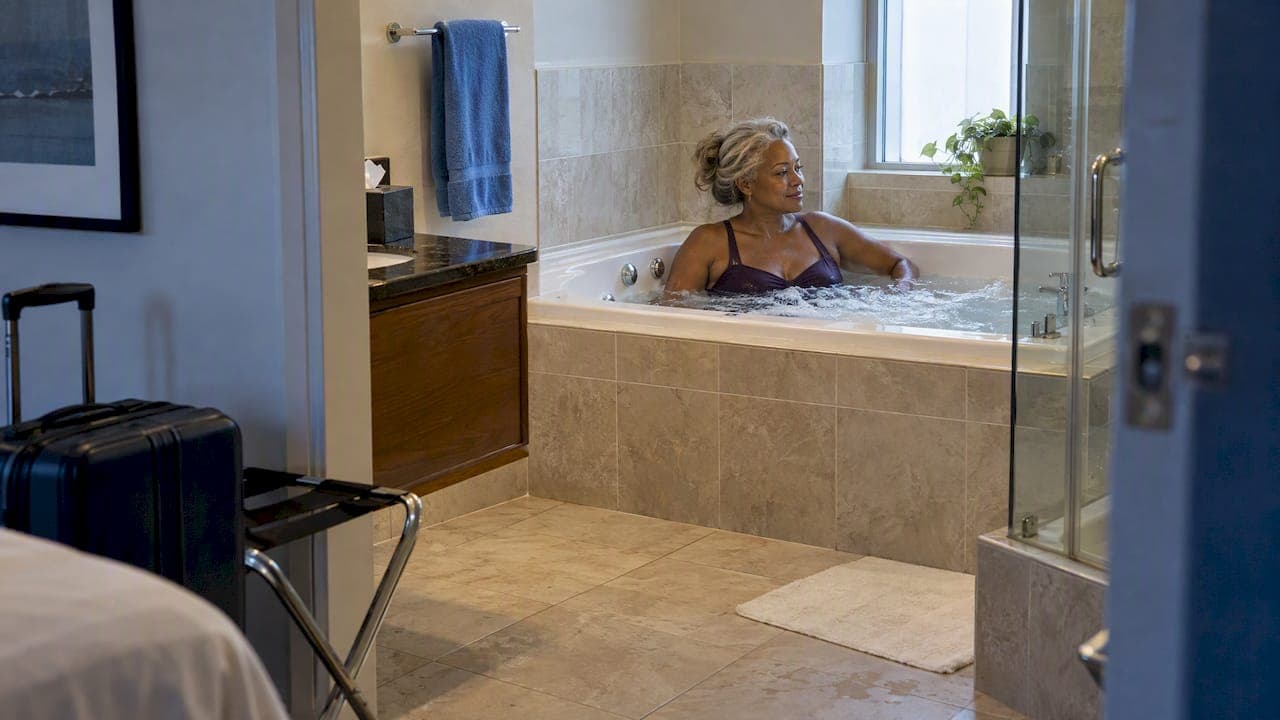
Yes, for most healthy adults a short, moderate soak after a flight is fine, and it can feel wonderful. Keep the water at or below 104°F, stay in 15 to 20 minutes, drink water first, skip the alcohol, and wait if you feel dizzy, light-headed or unusually drained. A hot tub is not a jet lag treatment, but a warm soak at the right time can help you wind down and sleep.
This guide covers what flying does to your body, how to soak safely when you land, and what to look for in a hotel so the tub in your room is the tub you expected.
TL;DR
- A short soak after flying is generally fine for healthy adults. Keep water at 104°F or lower and limit yourself to 15 to 20 minutes.
- Flying leaves you dry and tired, so drink water before and after, and skip alcohol before or during the soak.
- The CDC does not list hot tubs as a jet lag treatment. Daylight, hydration and sleep timing do the heavy lifting.
- Talk to your doctor first if you have high blood pressure, take prescription medication, are pregnant, or are at risk for blood clots after a long flight.
- A private in-room tub lets you control temperature, timing and cleanliness. Check the listing says exactly where the tub is.
Table of Contents
- What a flight does to your body before you ever get in the water
- Is it safe to use a hot tub after a flight?
- Who should check with a doctor first
- Can a hot tub help with jet lag?
- Shower first, shower after
- A quick safety check of the tub itself
- Why a private in-room tub suits a travel day
- Other ways to unwind after you land
- Our perspective
- Find a room where the tub is actually in the room
- A sample arrival-night routine
- FAQ
- Sources
What a flight does to your body before you ever get in the water
The cabin is a dry, low-pressure place. The Cleveland Clinic explains that air travel can leave you tired and dehydrated because cabin humidity is low and less oxygen reaches your body. Add early alarms, airport stress and a few hours in a seat, and you arrive at the hotel already a little depleted.
That matters because hot water asks more of your body. Heat widens blood vessels, raises your heart rate and makes you sweat. If you start from a dehydrated, tired baseline, the same soak you would shrug off at home can leave you woozy when you stand up.
Three things tend to go wrong after a flight:
- You are dehydrated. You may not feel thirsty, but you have been breathing dry air for hours.
- You had a drink on the plane or at the hotel bar. Alcohol and hot water are a poor pairing, more on that below.
- You are exhausted. Drowsiness in hot water is how people slip, stay too long or get overheated.
None of this means skip the tub. It means treat the first soak after landing as a gentle one.
Is it safe to use a hot tub after a flight?
For a healthy adult, a short soak at a sensible temperature is generally safe. There is no rule against soaking after a flight, and the public health guidance on hot tubs applies the same way whether you flew or drove. What changes is how careful you should be about the basics.
The temperature ceiling
The CDC states that hot tub water should not be higher than 104°F (40°C). King County public health officials add that hot water can feel different depending on the air temperature, so a reliable thermometer matters more than your hand. In a hotel room you rarely control the thermostat, so look for a visible gauge or ask the front desk. If you are tired and dehydrated, aim lower, in the range we cover in our guide to hotel jacuzzi temperature.
The time limit
At 104°F, King County guidance says to limit your soak to 15 to 20 minutes. The Alabama Department of Public Health says stays beyond 15 minutes in water near 104°F can cause hyperthermia, which can bring elevated blood pressure or drowsiness. So the well-known 15-minute rule is a public health recommendation tied to hot water, not a legal limit. After a flight, treat 15 minutes as a good first target and stop sooner if you feel off.

Hydration and alcohol
Safe Electricity recommends drinking plenty of water before and after soaking. The CDC advises against alcohol before or during hot tub use. Mayo Clinic notes that alcohol can affect your body's ability to regulate temperature, and that dehydration can contribute to heatstroke. If you suspect heatstroke, it says to get immediate medical help and call 911.
The romantic version of arrival night, with champagne in the tub, is the version to avoid. Have the toast after you get out, once you have had water.
Who should check with a doctor first
Some travelers should not improvise.
- High blood pressure or prescription medication. The Alabama Department of Public Health says these travelers should consult a physician before using a spa.
- Long flights and blood clots. The CDC says anyone traveling more than four hours can be at some risk, and that you should talk to your doctor before you travel if you think your risk is increased, for example after a previous clot. If you have a swollen, painful or warm leg after a flight, do not treat it with a soak. See a medical professional.
- Pregnancy. King County guidance says pregnant women should limit soaks to 10 to 15 minutes at a maximum of 102°F, and that longer soaks can cause fetal damage, especially in the first three months. Our page on hot tub safety during pregnancy walks through how to verify a room before you book. Ask your OB or midwife before you soak.
- Young children. The same King County guide says children under 5 should not use hot tubs. If you are traveling with kids, see whether a hot tub age limit applies to your hotel room.
Can a hot tub help with jet lag?
Not directly, and it is worth being honest about that. The CDC Yellow Book's chapter on jet lag disorder points to measures such as maximizing natural light after you arrive and avoiding lengthy daytime naps. It advises staying hydrated and avoiding excess alcohol while traveling. It does not list hot tub use as a treatment.
That said, warmth can help with sleep. CDC/NIOSH training material on warm baths says a bath of about 30 minutes taken within two hours of bedtime may promote sleep, but not immediately before bed. The reasoning is physiological: your body temperature rises during immersion and falls afterward, which mimics the temperature drop that normally comes before sleep.
This was written for shift workers, not for hot tubs, and a spa is hotter than a bath. So borrow the timing, not the duration. Here is how that plays out on a trip:
| Situation | Suggested approach |
|---|---|
| Land in the afternoon, bedtime is 10 p.m. | Get outside in daylight first. Soak for 15 to 20 minutes around 7 to 8 p.m. with water at 104°F or lower. |
| Red-eye, arrive in the morning | Do not soak straight into a nap. Get daylight, eat, hydrate, and soak in the evening so you sleep on local time. |
| Short domestic hop, no time change | Soak whenever you like, once you have had water and a shower. |
| Long-haul with a big time shift | Prioritize daylight and a sensible bedtime. Treat the soak as a wind-down, not a cure. |
The one trap is soaking in the morning after a red-eye, then falling asleep for four hours. The Yellow Book's advice about avoiding long daytime naps points the other way.
Shower first, shower after
You have been in a cabin, an airport and probably a rideshare. Rinse before you get in. The CDC recommends showering before hot tub use, and King County explains why: it removes perspiration and lotions that reduce disinfectant effectiveness. The same guide recommends showering afterward to wash away anything you picked up in the water.
One wrinkle: dermatologists quoted in a travel piece on post-flight showers say hot showers can dry out skin that is already parched from cabin air. So keep both showers lukewarm, and moisturize afterward. That is skin care advice, not a safety rule, but it fits the logic of the trip.
A quick safety check of the tub itself
A tired traveler is the person least likely to inspect the equipment, so do it in 60 seconds before you step in.
- Smell the room. The CDC says a properly chlorinated tub should have little odor, and a strong chemical smell signals a problem. Our 60 second chlorine check and cleanliness check cover what to look for.
- Look at the electrics. Safe Electricity advises travelers to inspect for damaged cords or exposed wires and confirm GFCI protection. If anything looks wrong, call the front desk and do not use it.
- Check the weather. The same source says to avoid hot tub use during thunderstorms, which matters for outdoor tubs on balconies and patios.
- Check the temperature. Use the gauge or a thermometer, not your instinct.
- Set a timer. Your phone is on the vanity. Use it.
When you leave the water, stand up slowly. Light-headedness on standing is the most common after-flight surprise.
Why a private in-room tub suits a travel day
After a flight, you want the tub on your terms. A shared hotel spa has opening hours, other guests, and water you cannot inspect or adjust. A tub in your room has none of those problems. You can soak at 8 p.m. or 6 a.m., keep it short, get out the moment you feel off, and be in bed in two minutes.
The catch is that hotel listings are vague. "Spa access" and "hot tub" can mean a shared pool-deck tub, a balcony tub, or a jetted tub in the bathroom. Our guide to balcony versus in-room hot tubs shows how to tell them apart, and our three questions to ask before you book cover safety. If you prefer to phone ahead, the call script for a private hotel hot tub tells you what to ask.

Matching the room to the trip
Different trips call for different tubs:
- Couples' weekend. Look at romantic hotels with a jacuzzi in the room.
- Want a bigger private setup. Browse jacuzzi suites or whirlpool suites.
- Prefer fresh air. Try hotels with a private hot tub, and remember the thunderstorm rule.
- Watching the budget. There are cheap hotels with a jacuzzi in the room and motels with a jacuzzi in the room.
- Want a pool and a tub. See hotels with an indoor pool and a hot tub in the room.
If you want to browse by place, SoakAtlas lists private jacuzzi and hot tub rooms by state. Some listings are in destination towns, for example Newpark Resort in Park City, Utah or Comfort Inn & Suites in Hot Springs, Arkansas, where an airport transfer or a drive ends with a tub waiting upstairs.
Other ways to unwind after you land
A soak is one option among several. Plenty of people feel better after a short walk in daylight, a full glass of water, a light meal and an early night. If you are traveling with colleagues or planning a trip as a reward, hotel amenities that help people decompress are part of the story, and wellness travel gift options show how much weight travelers now put on relaxation after the journey itself.
Our perspective
We built Hotel Hot Tubs because the worst arrival is the one where you carry your bags up, open the door and find the hot tub you were promised is a shared one downstairs, closed at 9 p.m. After a flight that is not a small disappointment. It is the whole reason you booked.
So we separate in-room, private and shared tubs, and we label the source of our verification, whether photos or reviews. You can see how that works on our verification page. We do not publish claims we cannot back up.
Our view on soaking after a flight is simple. Treat the first soak as a reset, not a performance. Drink water, keep it short, keep it moderate, and let the room do what a private tub is best at: letting you stop when you want to. If you have a health condition, ask your doctor before the trip, not at the tub's edge.
— Logan Oneal
Find a room where the tub is actually in the room
If you are planning a trip and want to land, check in and soak without hunting for answers, start with our directory of hotels with a jacuzzi in the room. You can filter by price, location, hotel chain, reviews and trip type, and every listing shows photos and guest feedback. When you are ready to book, you continue to a partner booking site to reserve.
A sample arrival-night routine
Here is how the pieces fit together on a typical evening, assuming you are healthy and your doctor has no objection:
- Arrive and drink. Have a full glass of water as soon as you reach the room. Keep a bottle at the tub.
- Get daylight if you can. A short walk outside helps your clock and loosens up legs stiff from the seat.
- Eat something light. Soaking on an empty stomach after a travel day is a recipe for feeling faint.
- Rinse off. Take a lukewarm shower before you get in.
- Check the tub. Smell, gauge, cords, weather.
- Soak 15 to 20 minutes. Water at 104°F or lower, timer on. Pregnant? Follow your clinician's advice, which is stricter.
- Get out slowly. Sit on the edge for a moment, then stand.
- Rinse again and moisturize. Keep the water lukewarm.
- Wind down. Dim lights, phone away, and go to bed at local time, not too long after the soak.
If you feel dizzy, nauseated, or confused at any point, get out, cool down and drink water. Persistent symptoms or suspected heatstroke mean calling 911.
FAQ
Is it safe to use a hot tub right after a flight?
For most healthy adults, yes, if the water is no hotter than 104°F and you stay in 15 to 20 minutes. Drink water first, skip alcohol, and rinse in the shower beforehand. If you have high blood pressure, take prescription medication, are pregnant, or worry about blood clots after a long flight, ask your doctor before you soak.
Will a hot tub cure jet lag?
No. The CDC's guidance on jet lag focuses on natural light, avoiding long daytime naps, hydration and limiting alcohol, and it does not list hot tubs as a treatment. A warm soak a couple of hours before bed may help you wind down and fall asleep, which can support your adjustment to a new time zone.
Why is there a 15-minute hot tub rule?
It comes from public health guidance. The Alabama Department of Public Health says stays beyond 15 minutes in water near 104°F can cause hyperthermia, with elevated blood pressure or drowsiness. It is a recommendation rather than a law, and after a flight a shorter soak is often the better choice.
Should I shower before or after using a hot tub?
Both. The CDC recommends showering before you get in, which keeps sweat and lotions out of the water. King County guidance recommends showering afterward to rinse off anything you picked up. Use lukewarm water if your skin feels dry from the flight.
Sources
- Cleveland Clinic: How Airplane Travel Affects Your Body
- CDC: What You Can Do to Stay Healthy in Hot Tubs
- King County Public Health: Staying Happy and Healthy in Your Spa & Hot Tub
- Alabama Department of Public Health: Hot Tub Safety
- Safe Electricity: Hot Tub Safety While Traveling
- Mayo Clinic: Heat stroke symptoms and causes
- CDC: Understanding Your Risk for Blood Clots with Travel
- CDC Yellow Book: Jet Lag Disorder
- CDC/NIOSH: Warm Bath relaxation technique
- Johnny Jet: Why You Should Avoid Taking a Hot Shower After a Flight