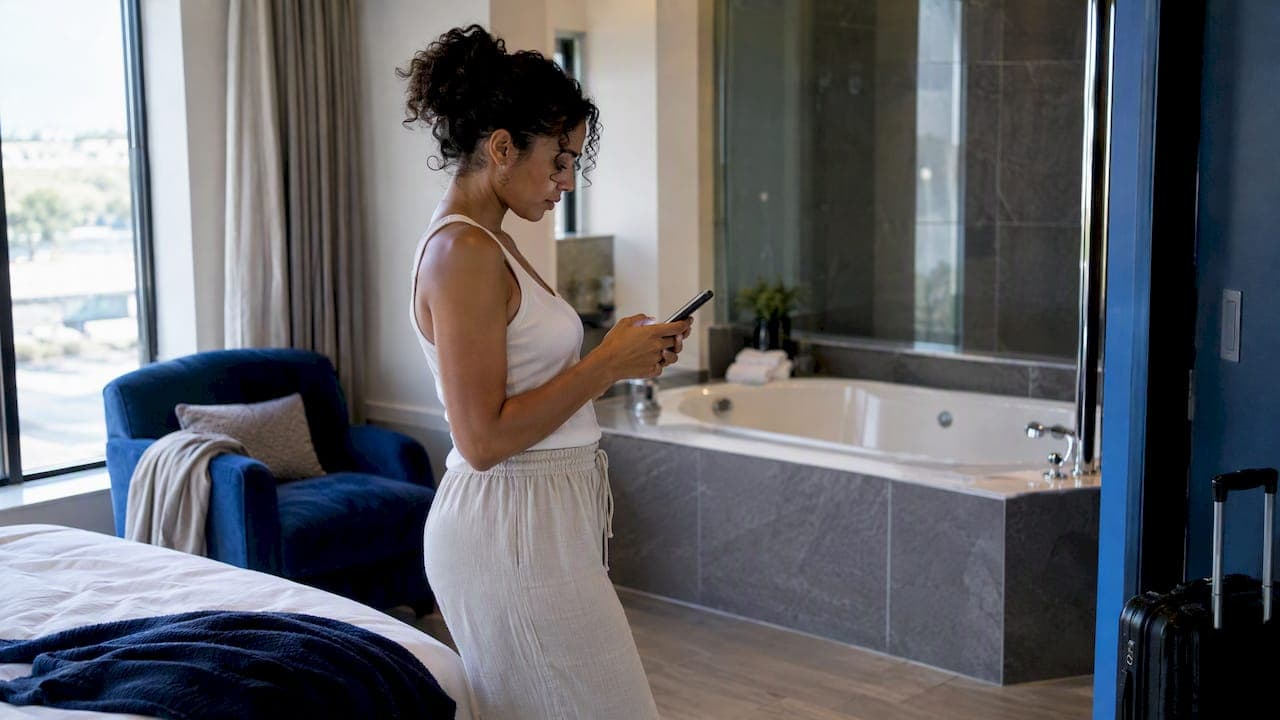
The fine print on a hotel's hot tub amenity decides whether you get a private soak in your room or a shared tub down the hall with posted hours. Before you book, check three things: where the tub is, who can use it, and what it costs on top of the room rate. Most listings answer only one of these, and some answer none.
This guide shows the phrases that cause trouble, the fees that hide behind them, and a short routine for confirming the tub before you pay. It is written for travelers who want a private jacuzzi, not a lobby spa.
TL;DR
- "Hot tub" on a listing can mean an in-room tub, a private balcony tub, or a shared one by the pool. Confirm which, in writing, before you pay.
- Mandatory daily fees (resort, destination, amenity) apply whether or not you use the tub. Read the taxes and fees breakdown, not just the nightly rate.
- Look for closure clauses, age limits, hours and "subject to availability" wording. They are where a promised soak disappears.
- Ask the front desk about the specific room number, water temperature and how the tub is cleaned between guests.
- Use a directory that verifies tub location with photos or reviews, so you are not decoding listings yourself.
Table of Contents
- Why hot tub listings are so easy to misread
- Phrases that signal a shared or conditional tub
- The fees behind the amenity
- Rules that restrict who can use the tub
- Water temperature and cleanliness: the safety fine print
- A five-minute routine to confirm your tub
- Our perspective: verified beats vague
- Find a room where the tub is confirmed
- What the fine print means for taxes and write-offs
- FAQ
- Sources
Why hot tub listings are so easy to misread
Booking sites list amenities as checkboxes. A single "hot tub" tick can sit on a property whose only tub is a shared one on the pool deck, open from 10 a.m. to 9 p.m. The checkbox is true for the hotel. It may be false for your room.
That gap is the reason we built Hotel Hot Tubs around one question: where is the tub, exactly? The fine print is where the answer lives, so it pays to read it like a contract.
Three separate things get blended under one word:
- Property amenity. The hotel has a tub somewhere. Everyone shares it.
- Room feature. Your specific room has a tub inside it, in the bathroom or the sleeping area.
- Private outdoor tub. A tub on your balcony, patio or fenced deck, attached to your room.
Only the second and third give you privacy. If you are unsure how the terms differ, our guide to jacuzzi vs hot tub explains what hotels mean by each word, and the spa tub meaning checklist covers the vaguest label of all.
Phrases that signal a shared or conditional tub
Some wording should slow you down. None of it proves a problem, but each phrase is a reason to ask a question.
| What the listing says | What it can mean | What to ask |
|---|---|---|
| "Hot tub on site" | A shared tub for all guests | "Is there a tub inside or attached to my room?" |
| "Access to spa facilities" | A paid or scheduled spa, not your room | "Is this included in the rate, and are there hours?" |
| "Suite with spa bath" | A deep soaking tub, possibly with no jets | "Does it have jets, and is it heated?" |
| "Select rooms feature a jacuzzi" | Only some room types, often a higher tier | "Does the room type I am booking include it?" |
| "Subject to availability" or "may be closed" | Maintenance closures with no refund | "What happens if the tub is out of service?" |
| "Seasonal" | Outdoor tubs closed in colder or off months | "Is it open on my dates?" |
| "Balcony hot tub" | Private, but exposed to weather and neighbors | "Is it screened from adjacent balconies?" |
The balcony case deserves its own caution, because a tub on a shared terrace is not the same as one on a private deck. We lay out the differences in 5 checks to avoid booking the wrong balcony or in-room hot tub.
The fees behind the amenity
A hot tub rarely adds a line on its own, but it often sits inside a bundle of charges. Hotels in many destinations add a mandatory daily fee on top of the advertised rate. Travel Fine Print notes that destination, resort and similar fees are often charged per night, and that you may see one price in search results and a different total at checkout, in the confirmation or at the front desk.

The same source advises checking the taxes and fees breakdown, because these charges can raise the total even if you never touch the pool or the tub.
A worked example
Say two rooms both advertise a jacuzzi.
- Room A is $189 a night with a $35 daily amenity fee, for a $224 effective nightly price.
- Room B is $205 a night with no added fee, for $205.
Over a two-night weekend, Room A costs $448 before tax and Room B costs $410. The cheaper-looking room costs $38 more. These numbers are illustrative, not quotes from any hotel, but the arithmetic is what you should do with every listing: multiply the nightly total, fees included, by the number of nights.
Other charges worth hunting for
- Cleaning or refill fees. Some properties charge when a tub must be drained and refilled after your stay. Ask whether any usage fee applies.
- Deposits. A refundable hold at check-in is common. Ask whether the tub is part of the damage terms.
- Spa access fees. A separate charge for a shared spa has nothing to do with an in-room tub, as our verified in-room jacuzzi guide points out. Do not pay it thinking it covers your room.
- Room-tier upgrades. The photo shows a jacuzzi suite, but the rate shown is for a standard room. Check that the room name in the confirmation matches the room in the photo.
Host-run rentals show the same pattern. Travelers on vacation-rental forums have complained about a surprise "hot tub service fee" added after booking, which is a good argument for reading the house rules before you pay.
Rules that restrict who can use the tub
Age limits
Many hotels bar children from hot tubs, or require an adult present. That can matter if you travel with kids and picked the room for the tub. See whether a hot tub age limit applies to your hotel room before you assume a family stay will work.
Pregnancy and health warnings
Most tubs carry a posted warning for people who are pregnant, have heart conditions, or take certain medications. If any of that applies to you, talk to your doctor before the trip, not at the tub. Our piece on verifying a safe hotel hot tub when pregnant goes through what to ask.
Hours and noise
Shared tubs usually close at night. Private in-room tubs often have quiet-hours rules or limits on filling late. Ask whether those apply, particularly if a late soak is the point of the trip.
Water temperature and cleanliness: the safety fine print
The CDC says hot tub water should never exceed 104°F (40°C), to reduce the risk of overheating. The same page covers disinfectant and pH levels that operators are expected to maintain. Many in-room tubs are not run like commercial pools, so a guest cannot assume anything about the water.
We suggest a simple approach: bring a small thermometer if you are sensitive to heat, and read the posted warning. For a longer explanation, see why we recommend aiming for 100 to 102°F.
Heat also matters for hygiene. The CDC's report on Pseudomonas folliculitis linked to pools and hot tubs described cases connected to hot tubs with inadequate maintenance, which is why the agency's guidance tells users to shower with soap before entering and to avoid swallowing the water. Its guidance on Legionella in hot tubs states that hot tubs have been associated with Legionnaires' disease outbreaks and should be run with proper disinfectant residuals and pH.
What that means at check-in:
- Look at the water before you get in. Cloudy water, a film on the surface or a musty smell is a reason to call the desk.
- Ask how the tub is cleaned between guests. Our 60 second jacuzzi check lists what to look for, and our note on chlorine in an in-room jacuzzi explains why some in-room tubs are treated differently from public ones.
- If the tub fails your inspection, ask for a different room or a refund of any tub-related charge before you use it, not after.
If you have a medical condition, a weakened immune system or a skin condition, ask your own clinician whether a hot tub soak is right for you.
A five-minute routine to confirm your tub
You do not need to read every line of every policy. Do this instead.
- Find the exact room type. Write down the name used in your booking confirmation, not the hero photo caption.
- Match the photos. Look for guest photos of that room type showing the tub. If only the lobby spa appears, be skeptical.
- Read the total price. Open the taxes and fees breakdown and calculate the all-in nightly cost.
- Scan the policies. Look for closures, age limits, hours, deposits and cancellation terms.
- Call the property. Ask about your room by type and say you are booking for the in-room tub. Our call script for a private hotel hot tub gives the exact questions.
- Get it in writing. Ask the hotel to note the room type and tub on your reservation, or send an email confirming it.
- Save your screenshots. If the listing changes later, you have a record of what you were promised.
This is also the point to decide what you will do if the tub does not work on arrival. Ask whether the hotel will move you, discount the stay or let you cancel. Most disputes go better when the answer was documented in advance.
Our perspective: verified beats vague
We built this directory because the common failure is not a lying hotel, it is an unclear listing. A property says "hot tub," a booking site shows a checkmark, and the guest fills in the rest with hope.
So we do one thing differently. For every stay we list, we record where the tub is (in-room, private or shared) and show the evidence behind that label, whether it is a photo or guest review. We do not publish a tub claim we cannot back up.

Our view on the fine print is that you should never have to hunt for the answer to the first question. The location of the tub belongs at the top of the listing. Fees, hours and age rules matter, but they matter after you know you are getting the tub you want.
When you are choosing between two rooms, pick the one where the evidence is easier to find. A property that makes the tub easy to verify is usually a property that expects you to use it.
— Logan Oneal
Find a room where the tub is confirmed
If you would rather skip the decoding, start with hotels with a jacuzzi in the room. You can filter by price, location, hotel chain, reviews and trip type. Looking for a particular style? Browse jacuzzi suites, hotels with a private hot tub, or romantic hotels with a jacuzzi in the room. On a tighter budget, the cheap hotels with a jacuzzi in the room page narrows the list, and the motels with a jacuzzi in the room page covers simpler properties.
Two examples of the kind of listing we show: Quality Suites in Graham, NC and Luxury Inn & Suites in Troy, MO. Each page shows the tub evidence, so you can judge it before you click through to book on a partner site. Fees and policies are still set by the hotel and the booking site, so run the routine above on the final checkout page.
What the fine print means for taxes and write-offs
One question comes up often among people who own tubs: can you write one off? Research on general tax principles says a hot tub is generally treated as a personal expense, deductible only when it is directly necessary for a trade or prescribed by a healthcare provider for an illness or injury. That is a homeowner's question, not a hotel guest's. A tub in your hotel room is part of the room price and does not change how the stay is treated. For anything specific to your return, ask a tax professional.
FAQ
Does a "hot tub" in the amenities list mean it is in my room?
Not necessarily. It often refers to a shared tub on the property. Check the room description and guest photos for your room type, then ask the hotel to confirm in writing that your room has its own tub.
Do I have to pay a resort fee if I do not use the hot tub?
Usually yes. Mandatory destination or resort fees are charged per night whether or not you use the amenities, according to Travel Fine Print. Look at the taxes and fees breakdown before you book, and compare the all-in nightly price between hotels.
What should I do if the hot tub is broken when I arrive?
Report it to the front desk right away and ask for a room with a working tub, a partial refund or cancellation. Take photos of the problem. If you asked about the tub before booking and have the answer in writing, your request is much easier to make.
Is the water in a hotel jacuzzi safe?
It depends on how the tub is maintained. The CDC says germs can spread through hot tub water and cause skin, respiratory or stomach illnesses, so look at the water, shower first and do not swallow it. If it looks cloudy, skip it and tell the desk.
Sources
- Hotel Destination Fees Explained: Do You Have to Pay? (Travel Fine Print)
- What You Can Do to Stay Healthy in Hot Tubs (CDC)
- Pseudomonas Dermatitis/Folliculitis Associated With Pools and Hot Tubs (CDC MMWR)
- Controlling Legionella in Hot Tubs (CDC)
- Senior thesis on business and personal expense deductions (Liberty University)