
Pick an in-room jetted tub when privacy, romance, or late-night soaking matter more than square footage. Pick a hotel spa hot tub or a cabin's shared deck tub when you want space, a social scene, or don't plan to use it more than once. The catch either way is hygiene: a private tub gets drained and refilled per stay, while a shared hot tub relies on constant chemical upkeep, so verify before you book instead of trusting the listing photo.
TL;DR:
- Private in-room jetted tubs are drained after each stay, reducing contamination risk, but hygiene still depends on regular cleaning of jets and internal lines.
- Shared hot tubs rely on continuous chemical treatment and frequent inspections, with about 15% being closed annually due to health violations.
- Listing descriptions often mislead with the term "jacuzzi," so verifying photos and guest reviews is essential to confirm privacy and actual amenities.
- An upgrade to a jacuzzi suite is worthwhile if you plan multiple uses or value late-night access, but not if you only want a single quick soak.
- Outdoor deck tubs add weather considerations, while indoor shared tubs usually close early, influencing your choice based on trip timing and weather.
Table of Contents
- In-Room Jacuzzi vs Spa: What's Actually Different
- Is a Hotel Hot Tub Actually Sanitary?
- Privacy, Noise, and Weather: The Parts Listings Never Mention
- Is the Nightly Upgrade for a Jacuzzi Suite Worth It?
- Which Option Fits Your Trip: A Quick Decision Guide
- How to Confirm a "Jacuzzi Room" Is Actually Private
- What Ten Years of Hotel Listings Taught Me About This Question
- Skip the Guessing Game on Jacuzzi Listings
- Sources
- FAQ
In-Room Jacuzzi vs Spa: What's Actually Different
The terms get thrown around loosely in hotel listings, and that's the root of most booking disappointment. An in-room jetted tub is filled once per guest and drained when you check out. It runs on your bathroom's plumbing, not a filtration loop, so there's no continuous chemical treatment happening while you soak. A hot tub or spa, by contrast, stays filled around the clock. It relies on pumps, filters, and a chemical dosing system to keep the same water clean for dozens of guests a day.
That mechanical difference drives almost everything else about the experience:
- Capacity and jets: In-room tubs typically fit one or two people and run on standard household jet pressure. Shared hot tubs seat four to eight and often have stronger, adjustable jet zones.
- Placement: Jetted tubs sit in the bathroom or a suite alcove. Hot tubs live on a deck, poolside, or in a dedicated spa room.
- Access hours: A private in-room tub is yours 24/7. A shared hot tub posts hours, usually closing by 10 or 11 p.m. for noise and staffing reasons.
- Temperature control: In-room tubs often lack a thermostat and just use hot tap water. Hot tubs hold a set temperature, usually in the upper 90s to low 100s Fahrenheit.
One quirk worth knowing: some listings say "jacuzzi tub" when they mean a jetted bathtub, and some say "hot tub" when they mean a shared amenity two floors down. Jacuzzi® is a registered trademark, not a generic word for any jetted fixture, and hospitality copy mixes it up constantly. A consumer explainer on the differences confirms this confusion is common enough that travelers should never assume based on the word alone. Our own breakdown of jacuzzi vs. hot tub terminology walks through the exact phrases that tend to mislead.
Is a Hotel Hot Tub Actually Sanitary?
Both setups can be clean. Both can also be neglected. The difference is what "clean" requires from the operator.
Public hot tubs need constant chemical management because the same water serves a rotating pool of guests. The CDC recommends pH between 7.2 and 7.8 and free chlorine residuals of 3 to 10 parts per million, checked frequently throughout the day. Warm water in the 77 to 113°F range is also the sweet spot for Legionella growth, which is why the CDC's hot tub module calls for automatic disinfectant feed systems and twice-daily residual checks.
By the numbers: Routine inspections have resulted in the immediate closure of roughly 15% of public hot tubs for health code violations, according to CDC-cited data.
That's not a reason to avoid every hotel hot tub. It's a reason to ask questions before you rely on one for a special trip.
In-room jetted tubs sidestep the shared-water risk entirely since each fill is single-use, but the jets and internal lines can still harbor residue if housekeeping doesn't run a cleaning cycle between guests, a detail travel plumbing guides confirm matters more than most travelers assume.
Three checks worth making before you soak:
- Ask the front desk how often the hot tub is inspected and whether logs are posted.
- Request clarification on jetted-tub cleaning between stays, not just towel service.
- Skip either option, or check with a doctor first, if you're pregnant or immunocompromised.
Privacy, Noise, and Weather: The Parts Listings Never Mention
An in-room tub gives you total control. You choose the lighting, the volume, whether wine is allowed within arm's reach of the water, and whether you're getting in at 7 a.m. or 1 a.m. A hotel spa or resort hot tub is a shared social space by design, with posted rules about glass containers, food, and often a lifeguard or attendant nearby.
Outdoor deck tubs, common at cabins and mountain resorts, add weather into the equation. A private hot tub with private outdoor hot tubs listings can be a highlight in cool weather and a liability in a downpour. Indoor shared tubs solve the weather problem but usually close early.
- Music and lighting: fully yours in-room; fixed or absent in a shared spa.
- Alcohol and food rules: flexible in-room; often restricted or banned poolside.
- Weather exposure: only relevant to outdoor deck tubs, private or shared.
Pro Tip: If ambiance matters as much as the soak itself, call the hotel directly and ask whether the in-room tub has a view or window. Listing photos rarely show this, and it's often the detail that makes or breaks the room.
Is the Nightly Upgrade for a Jacuzzi Suite Worth It?
Hotels price this two ways: a flat per-night surcharge for a "jacuzzi suite," or a resort fee that bundles spa access whether you use it or not. Neither is inherently the better deal.
The upgrade earns its cost when you'll actually use the tub more than once, want night access, or are booking specifically for a romantic occasion. It's a weaker bet if you expect one 20-minute soak on a single evening, since a shared hot tub included in a lower base rate delivers the same relaxation for less.
- Compare the suite surcharge against the resort fee for spa access before assuming either is cheaper.
- Ask whether the "jacuzzi" fee includes unlimited access or a scheduled window.
- Watch for capacity caps. Some jetted suites are priced for two but only fit comfortably for one.
Travelers hunting for the upgrade without the premium price tag can check cheap hotels with jacuzzi rooms under $250, where the surcharge tends to be modest rather than a full room-category jump.
Which Option Fits Your Trip: A Quick Decision Guide
- Couples and romantic getaways: An in-room jetted tub wins for privacy and the flexibility to soak whenever you want. Browse romantic hotels with a jacuzzi in the room for options built around exactly this.
- Families and groups: A cabin deck tub or shared hotel spa gives you room to spread out and socialize, something a two-person bathroom tub can't offer.
- Wellness and recovery trips: A resort spa with staff-run hydrotherapy suits travelers chasing a structured treatment; an in-room tub suits anyone who just wants private heat therapy on their own schedule. Either way, short hot-soak sessions of 10 to 20 minutes are the safer target, with hydration in between.
- Anyone with a heart condition or pregnancy: Talk to a physician before either option. Warm water immersion isn't medical therapy, and both settings raise heart rate and core temperature in ways that matter for certain conditions.
How to Confirm a "Jacuzzi Room" Is Actually Private
Listing language is where most bad bookings start. "Jacuzzi room" can mean a private jetted tub, a room near a shared hot tub, or nothing more than a marketing flourish left over from a previous renovation. Since Jacuzzi® is a brand name, not a category, a hotel technically misuses it any time they apply it to a generic jetted fixture, which happens often enough that the wording alone shouldn't decide your booking.
Photos are your best evidence. Look for a shot that shows the tub with visible bathroom or bedroom features in frame, like a window, TV, or bed corner, confirming it's inside the actual guest room rather than in a communal area. Cross-check that against recent guest reviews mentioning the tub by name.
- Confirm the amenity caption explicitly says "in-room" or "private," not just "jacuzzi."
- Look for at least one photo showing the tub alongside recognizable room furniture.
- Cross-reference two or more recent reviews that mention using the tub themselves.
Pro Tip: Save a screenshot of the listing description the moment you book. If the room doesn't match what was promised, you'll have proof to bring to the front desk or the booking platform.
Our three-question hotel check before you book and 60 to 90 second verification guide walk through this exact process in more detail.
What Ten Years of Hotel Listings Taught Me About This Question

Most disappointment with in-room tubs traces back to one habit: trusting the room name over the room photo. "Whirlpool Suite" and "Jacuzzi Room" get slapped on inventory that sometimes hasn't had a working jet in years. My rule of thumb is simple: if a listing can't show me the tub inside four walls I recognize as a bedroom or bathroom, I assume it's shared or missing entirely.
The one habit worth stealing is boring but effective: screenshot your confirmation and save the listing URL the day you book, not the day you check in. Prices, room descriptions, and amenity photos get swapped more often than most travelers expect, and comparing a golf resort's spa-and-treatment package against a plain in-room tub listing only works if you have the original wording on hand.
— Logan Oneal
Skip the Guessing Game on Jacuzzi Listings
Hotel Hot Tubs exists because "jacuzzi room" on a booking site is too often a guess dressed up as a fact. Every listing here gets checked against photo evidence and guest reviews before it's tagged as a true in-room, private amenity, so you're not relying on marketing copy written by someone who's never seen the room.
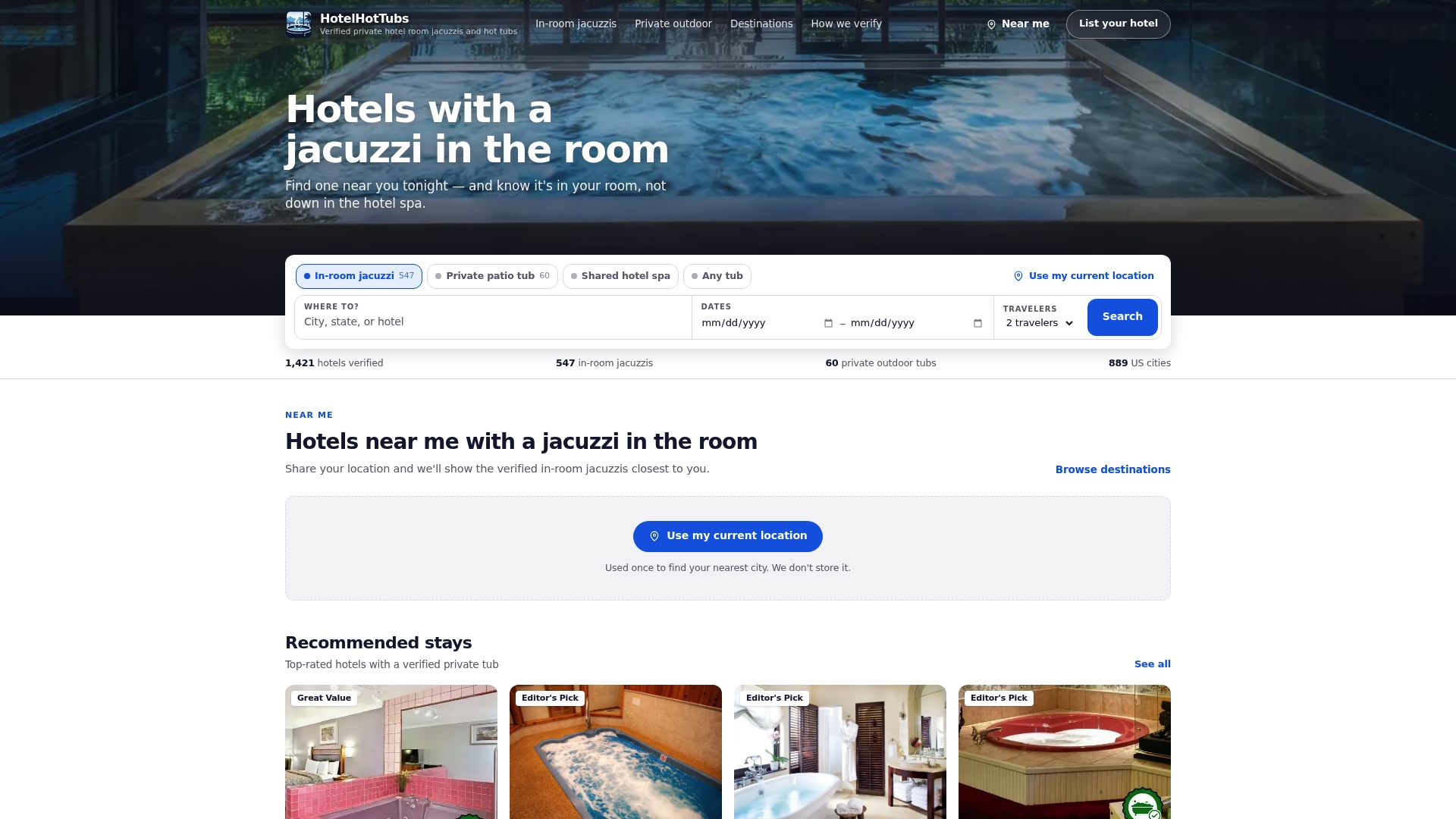
Filter by what actually matters to your trip: whirlpool suites for classic jetted-tub rooms, private outdoor hot tubs if you want a deck setup instead of a bathroom fixture, or hotels with an indoor pool and a hot tub in the room if you're traveling with a group that wants both. Start your search on the main Hotel Hot Tubs directory and book the room you actually saw, not the one the listing implied.
Sources
- Our Trademark | Jacuzzi® | Jacuzzi® EMEA
- Operating public pools, hot tubs, and splash pads | Healthy Swimming | CDC
- What's the difference between Jacuzzis, hot tubs, and spas? | The Spruce
FAQ
What Is a Room With a Jacuzzi Called?
Hotels typically label it a "jacuzzi suite," "whirlpool suite," or "jetted tub room," though the terms aren't standardized across properties. Check listing photos and guest reviews rather than the room name alone, since Jacuzzi® is a specific brand that many hotels apply loosely to any jetted fixture.
Why Are Jacuzzi Tubs Out of Style?
Some renovations have phased out in-room jetted tubs because the jets are hard to clean thoroughly and take up bathroom space guests increasingly want for walk-in showers. That said, plenty of hotels still offer them specifically because travelers request the privacy, and directories like Hotel Hot Tubs exist to help find those remaining rooms.
Is a Hot Tub or Spa Better?
Neither is universally better. A shared hot tub offers more space and a social setting, while an in-room private tub offers privacy, flexible hours, and no shared water. The right pick depends on whether your trip is about romance and control or about group time and amenities.
Which Hot Tub Option Is the Best Value for the Money?
An in-room jetted tub is the better value if you'll use it repeatedly or want private access at odd hours, since you're not paying for spa infrastructure you won't touch. A resort with included spa access often wins if you only plan one soak, because the cost is spread across the whole stay rather than concentrated in a room upgrade. Compare options through cheap hotels with a jacuzzi in the room before assuming either route is automatically cheaper.