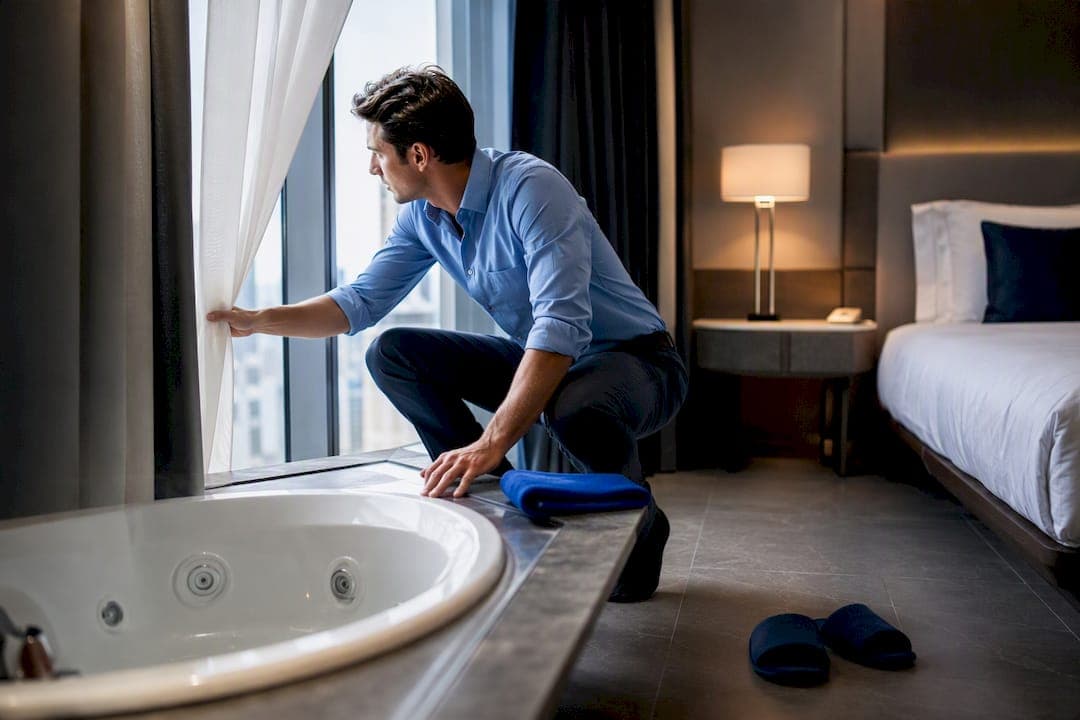
Yes, you can book a truly private Jacuzzi suite. The reliable way is to book a verified in-room listing and confirm a short checklist before arrival, since exclusive access and documented maintenance matter more than a marketing label. Look for exact tub placement, photo proof, and a real turnover routine, then verify occupancy limits so your privacy expectations match the room you actually get.
TL;DR:
- Verify that the jacuzzi is located inside the room, on an enclosed balcony, or in a fully fenced outdoor enclosure to ensure genuine privacy.
- Confirm the tub is exclusively accessible with a separate lock, has documented regular cleaning and disinfectant testing, and check for verified guest reviews or photos.
- Be aware that indoor tubs offer the highest privacy, outdoor enclosures with fencing and gates are secure, while shared-area tubs provide no real seclusion.
- Ensure the property tests for safe water temperatures below 104°F, maintains proper chemical levels, and keeps detailed maintenance records before booking.
- Book at least three to six weeks in advance for verified private suites and request a full breakdown of fees, including resort charges and cleaning costs, before confirming.
Table of Contents
- Checklist: how to confirm a jacuzzi is truly private
- Where the tub sits changes what privacy actually means
- Health and safety essentials worth verifying before you soak
- What to ask when booking and the red flags that mean you should walk away
- What actually happens at check-in and during your stay
- When to book for the best privacy and availability
- What a jacuzzi suite actually costs beyond the room rate
- How privacy features differ across hotel types
- What guests actually say about jacuzzi suite privacy
- Why verified listings beat marketing labels
- Find a verified private jacuzzi suite without the guesswork
- Sources
- FAQ
Checklist: how to confirm a jacuzzi is truly private
The word "private" gets printed on a lot of listings that turn out to mean a hot tub on a shared patio or a balcony facing the parking lot. Before you hand over a deposit, run through a short verification routine that treats privacy as something you can document, not something you have to trust.
- Ask for the exact tub location, whether it sits inside the room, on an enclosed balcony, or in a shared courtyard, and request a recent photo showing the surrounding walls, windows, and doors.
- Confirm exclusive access: does the room lock separately, and does anyone besides housekeeping have a key or a reason to enter while you're there?
- Ask directly whether the tub is fully drained and cleaned between guests, and how often the property tests disinfectant and pH levels.
- Request documented evidence beyond marketing copy: guest photos, reviews that specifically mention privacy, or a verification badge tied to a real inspection.
- Confirm the room's occupancy limit and check whether any shared-access windows exist, such as scheduled maintenance visits or a spa area other guests can book into.
A property that answers these questions quickly and specifically is usually telling the truth. One that hedges, or answers a different question than the one you asked, is worth a second look. The Couples' 10 Minute Checklist walks through this same process in more detail if you want a version to bring to check-in.
Pro Tip: Send your verification questions in writing, by e-mail or chat, so you have a record to point to if the room doesn't match what you were told.
Where the tub sits changes what privacy actually means
Not all "private" tubs deliver the same experience, and the placement tells you almost everything you need to know before you book.
- Indoor in-room tubs usually give the strongest seclusion since the tub is behind the same locked door as the bed; still confirm there's no interior window facing a hallway or connecting room.
- Balcony or patio tubs can be genuinely private, but only if the balcony has real screening, enough elevation, and no direct sightline from neighboring rooms or a public walkway.
- Private outdoor enclosures with fencing and a locked gate function like an in-room tub in practice, while a semi-private terrace that shares a fence line with another unit does not.
- Shared-area tubs, including rooftop or lobby-adjacent spas, offer no real privacy at all, though they can still suit a traveler who wants a hot tub experience without paying for an in-room unit.
If seclusion is the whole point of the trip, an indoor tub or a fully enclosed outdoor unit removes the guesswork. Guests who want the outdoor feel without sacrificing privacy can compare private outdoor hot tub listings or read through the placement breakdown in this guide to in-room versus outdoor tubs. Balcony seekers should look specifically at how a property handles hot tubs on the balcony, since sightline issues show up there more than anywhere else.
Health and safety essentials worth verifying before you soak
Privacy shouldn't come at the cost of basic safety, and the two checks take about the same amount of effort.
CDC guidance sets 104°F (40°C) as the maximum safe hot tub water temperature, and recommends that children under 5 avoid hot tubs entirely, along with anyone who is currently ill. The same guidance advises against alcohol before or during use and recommends a quick shower before getting in.
On the maintenance side, CDC operator guidance recommends keeping pH between 7.0 and 7.8 and maintaining free chlorine at 3 ppm or higher, or bromine between 4 and 8 ppm, testing frequently because small water volumes at high temperatures can drop disinfectant levels fast.
- Ask whether the property tests disinfectant and pH at each guest turnover, not just on a general schedule.
- Ask whether the water-management program covers Legionella risk specifically, since CDC hospitality guidance identifies regular maintenance as a key control for hotels and vacation rentals.
- Request the frequency of filter changes and disinfectant checks in writing if the front desk can't answer on the spot.
- Don't assume "private" means unsupervised or unlimited: posted temperature limits and safety instructions should still be visible in the room.
Private tubs need the same attention as public ones. The CDC's Legionella control toolkit for hot tubs recommends monitoring free chlorine at 3 to 10 ppm or bromine at 4 to 8 ppm, keeping pH between 7.2 and 7.8, and maintaining operating records, guidance that applies whether the tub sits in a hotel lobby or inside your own room. Politely asking for a maintenance log or a recent inspection note is a reasonable request, and a property confident in its upkeep will usually produce one without pushback.
What to ask when booking and the red flags that mean you should walk away
A five-minute phone call or chat message before booking saves you from arriving to a tub that's technically on-site but nowhere near private.
- Ask directly: "Is the tub inside the room, or somewhere else on the property?"
- Ask: "Do you drain and fully clean the tub between guests, and how often do you test the water?"
- Ask for a recent photo that shows the tub's surroundings, including any windows, shared walls, or sightlines from outside the room.
- Treat vague or evasive answers as a signal, especially if the property can't confirm turnover cleaning or won't send a photo.
- Cross-check the answers against recent guest reviews, since contradictions between what staff say and what guests report are one of the more reliable warning signs.
Using verified in-room listings instead of a general search removes most of this back-and-forth, since the tub location and access details are confirmed before the listing goes live. If you arrive and the room doesn't match what was promised, ask for an immediate room change or a refund; most properties will accommodate a legitimate mismatch between the listing and the reality, especially when you can point to the specific claim that didn't hold up. The step-by-step booking guide covers how to phrase these requests if you're not sure where to start.
What actually happens at check-in and during your stay
Most properties run a short safety routine at check-in that touches your tub directly: a mention of the temperature limit, an emergency contact number, and a scheduled housekeeping window. None of that has to interfere with your privacy if you know what to expect going in.
Hotels balance privacy with safety by limiting who has a reason to enter the room while still keeping emergency access available, which usually means a locked door, a do-not-disturb sign that's actually honored, and a housekeeping schedule you can shift or skip for the length of your stay.
- Shower before using the tub, both for hygiene and because it's the guidance most properties post in the room.
- Limit alcohol before or during use, since the combination with hot water raises the risk of dizziness or overheating.
- Use curtains, blinds, or privacy screens fully, and check that locks engage properly on arrival.
- Schedule housekeeping for a time you'll be out, rather than leaving it open-ended.
Pro Tip: A quick call to the front desk to move your housekeeping window is usually enough to guarantee uninterrupted time in the tub.
When to book for the best privacy and availability
Jacuzzi suites, especially fully private in-room units, make up a smaller share of a hotel's inventory than standard rooms, which means they sell out faster around weekends and holidays. Booking three to six weeks ahead gives you the best odds of getting the specific room type you verified rather than a substitute the property offers once the private units are gone.

Midweek stays are generally easier to secure on short notice since demand for romantic getaways concentrates on Friday and Saturday nights. If your dates are flexible, checking availability for a Sunday through Thursday stay often opens up rooms that were fully booked for the weekend.
Holidays and Valentine's week are the tightest windows of the year for this category of room, so properties with only one or two verified private units tend to book those out months in advance. If a specific hotel is the goal rather than just the amenity, reach out directly once you've verified the room through a checklist, since some properties hold back a private suite for guests who call ahead.
What a jacuzzi suite actually costs beyond the room rate
The advertised room rate rarely tells the whole story. Resort fees, often charged per night regardless of whether you use the amenities they claim to cover, are common at properties with in-room hot tubs, and they should show up before you complete checkout, not as a surprise on your final folio.
Some properties also charge a cleaning fee specific to the tub, since draining and sanitizing a jacuzzi takes more staff time than turning over a standard room. A refundable damage deposit is common as well, particularly at independent hotels and motels rather than large chains, and it's usually released within a few business days of checkout if nothing is damaged.
Ask for a full breakdown of fees before you book rather than after, since resort fees and cleaning charges are the two line items most likely to turn a budget listing into a mid-range one. Readers working with a tighter budget can compare lower-cost jacuzzi suite options that still list their fees upfront.
How privacy features differ across hotel types
Large chain hotels with in-room jacuzzi suites tend to standardize the room layout, which makes verification easier since photos and floor plans are usually consistent property to property. The trade-off is that chain suites often sit on upper floors near other rooms, so window placement and soundproofing matter more than they do at a standalone property.
Independent hotels and boutique properties vary more widely. Some offer fully enclosed private terraces that beat anything a chain typically builds, while others advertise a "private" tub that turns out to be on a shared rooftop deck. Motels marketed around in-room jacuzzis often deliver strong privacy simply because the room layout puts the tub behind the same door as the bed, with no shared balcony or patio involved at all.
There's no universal ranking that holds across every property in a brand, which is exactly why placement verification matters more than brand reputation. A general suite category page spanning multiple price points and hotel types is a more reliable starting point than assuming any one chain guarantees privacy by name alone.
What guests actually say about jacuzzi suite privacy
Guest reviews are often the most honest source of information you'll find, since they describe what a stay was actually like rather than what a listing promised. Reviews that specifically mention sightlines, whether a curtain fully closed, or whether a neighboring balcony could see into the tub area tend to be more useful than star ratings alone.
Photos guests post themselves, rather than the ones a property selects for its own listing, are particularly valuable because they show the room as it exists rather than as it's staged. A recurring theme in feedback tied to verified listings is relief that the room matched expectations exactly, with no surprise shared access or unexpected sightlines once the door closed.

When comparing properties, weigh recent reviews that mention privacy by name more heavily than older reviews or generic five-star ratings with no detail. A single specific mention of a closed curtain or an enclosed patio tells you more than a dozen reviews that only mention the water temperature.
Why verified listings beat marketing labels
Most disappointment with a "private" jacuzzi suite traces back to one thing: the word private meant something different to the hotel's marketing team than it did to the guest. Hotel Hot Tubs built its listings around documenting the exact tub location with photo or review evidence rather than repeating whatever label a property chooses to use. That distinction, verified placement versus a marketing claim, is the one that actually predicts whether your stay matches your expectations.
Save your confirmation emails and any photos the property sends you, and bring the checklist questions to check-in rather than assuming the booking process covered everything. A few minutes of documentation up front consistently prevents the worst surprises.
— Logan Oneal
Find a verified private jacuzzi suite without the guesswork
Booking a jacuzzi suite usually means digging through listings that call a shared rooftop spa "private" or bury the real tub location three photos deep. A trustworthy directory verifies exact tub placement with photo or review evidence before listings go live, so you can filter for in-room tubs specifically rather than sorting through properties that only offer shared amenities.
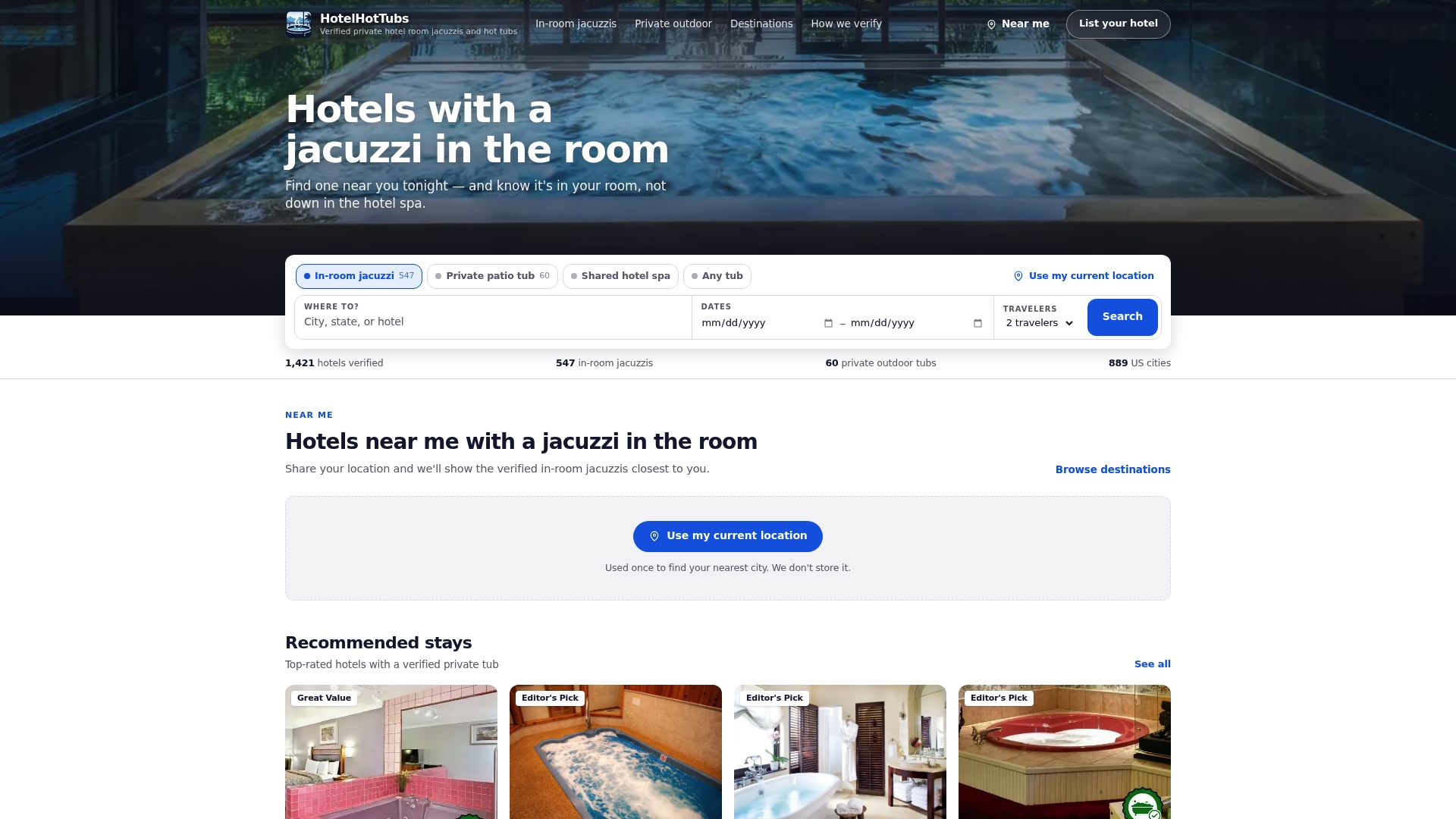
The main directory lets you search by location, price, and hotel type, and every listing states clearly whether the tub sits inside the room, on a balcony, or in a shared area.
- Filter by verified in-room status before you compare prices, so you're not weighing a private suite against a shared spa by accident.
- Run the Couples' 10 Minute Checklist against any listing you're considering, even ones found elsewhere.
- Contact the property directly with the booking questions from this guide before you pay a deposit.
For a romantic getaway specifically, the romantic jacuzzi suite category narrows the search to properties built around that exact experience, with the same verification standard applied across every listing.
Sources
The safety and occupancy guidance in this article draws on CDC hot tub safety guidance, CDC Legionella control resources, and federal fire-prevention code for occupancy questions.
This article is general information, not a substitute for advice from a qualified doctor. Consult a qualified healthcare professional about your own circumstances before acting on anything here.
- What You Can Do to Stay Healthy in Hot Tubs | Healthy Swimming | CDC
FAQ
Why are hotels getting rid of hot tubs?
Some properties have phased out in-room and shared hot tubs due to the maintenance demands involved, since CDC guidance requires regular water-management attention to control Legionella risk. This makes verified listings more useful than ever, since the properties that still offer them tend to take upkeep seriously.
How can I make my hot tub private?
The most reliable way is to confirm exact tub placement before booking: an indoor in-room tub, a fully enclosed patio, or a screened balcony with no direct sightlines from neighboring rooms. Ask the property for a recent photo and confirm exclusive access rather than relying on the word "private" in the listing.
What is the 5-foot rule for hot tubs?
There's no universal five-foot rule governing hotel hot tub occupancy or placement; capacity and safety requirements come from a property's own posted limits combined with local building and fire codes. If you've seen this figure referenced elsewhere, treat it as a rule of thumb rather than a binding standard, and confirm the actual limit with the property.
Do hotels mind if 5 people stay in a 2-person room?
Occupancy limits are set by the property and by local codes, not a single nationwide standard, so a room booked for two guests typically cannot accommodate five without violating the hotel's posted policy. Exceeding the stated occupancy can affect both your privacy, since a two-person jacuzzi suite isn't built for a larger group, and your booking terms, so confirm the limit before arrival if your group size is in question.