
The best solo hot tub experiences come from three sources: private in-room jacuzzis, small wellness retreats that welcome single guests, and unique setups like hot tub boats or private cabins. Directories exist that help you confirm a tub is genuinely private before you book, and the CDC sets the safety baseline: never soak above 104°F and only in a properly maintained tub.
TL;DR:
- Verified in-room jacuzzi listings help ensure privacy and avoid misleading marketing descriptions that often imply shared or communal tubs.
- Private in-room tubs give solo travelers full control over soak duration and temperature, making them safer and more comfortable than communal spas.
- Checking water clarity, temperature, and ventilation conditions upon arrival can prevent health risks and ensure proper maintenance before use.
- Maintaining CDC-recommended water chemistry and avoiding prolonged or alcohol-involved sessions reduces the risk of Legionella and other waterborne bacteria.
- When booking, ask explicitly about tub privacy, maintenance schedules, and accessibility features to find suitable options for solo travelers with mobility needs.
Table of Contents
- Why hot tubs work well for solo travelers
- Where to find solo-friendly hot tub stays and experiences
- Your 60-second checklist before you book and when you arrive
- Health and safety guidance every solo soaker should know
- Solo soaking etiquette and comfort tips
- Managing personal belongings and security while using a hot tub alone
- Accessibility considerations for solo travelers with mobility issues
- What I've learned booking solo hot tub stays
- Skip the guesswork with verified in-room jacuzzi listings
- Sources
- FAQ
Why hot tubs work well for solo travelers
Traveling alone means nobody else decides when you soak, how long you stay in, or what temperature feels right. A private in-room tub puts you in full control, which matters more on a solo trip than it does when you're splitting a hotel room with a partner or a family. Communal spas can feel exposing when you're by yourself, especially at busy resorts where you're the only person soaking solo.
The relaxation and muscle recovery benefits are real reasons to plan a soak into a solo trip, particularly after a long flight or a day of hiking. That said, communal soaking isn't automatically a bad choice. Small, curated retreats and hot tub boat rentals often work fine for one person, especially when the group size is naturally small or the experience is designed around individual time slots.
A few signs tell you a communal or shared setup will suit a solo traveler:
- The property markets directly to solo guests or couples, not large groups.
- Reviews mention other solo travelers using the space comfortably.
- Booking is by time slot or private reservation rather than open access.
If none of those apply, a private in-room tub is the safer bet for comfort and privacy.
Where to find solo-friendly hot tub stays and experiences
Finding a genuinely private tub takes more digging than a standard hotel search, because listing language is often vague on purpose.
- In-room private tubs. Look for listings that explicitly say "in-room jacuzzi" or "private spa tub," not just "spa access" or "hot tub on site," which usually means a shared facility.
- Wellness retreats and boutique spas. Some wellness retreats and boutique spas build their packages around solo guests, offering private soaking windows and schedules that don't require pairing up with strangers.
- Hot tub boats and private cabins. Rental boats with onboard hot tubs let one person pilot and soak at the same time, though sessions run a few hours and weather can cancel plans.
- Verification tools. Some directories exist specifically to confirm tub type and location before you commit money to a room.
For solo travelers on a budget, cheap hotels with a jacuzzi in the room can still deliver a private tub without the price tag of a full retreat package, and jacuzzi suites near your destination are worth checking before you settle for a standard room with shared spa access.
Your 60-second checklist before you book and when you arrive
Before you pay for anything, ask the property two direct questions: is this a continuously heated hot tub or a jetted bathtub, and is it private to the room or shared with other guests. Also ask about the maintenance schedule, since a tub that's cleaned infrequently is a health risk, not just a comfort issue.
Once you check in, run this quick test before you get in:
- Turn on the jets while the tub fills and listen for grinding or irregular noise.
- Check water clarity: cloudy water or a strong chemical smell are red flags.
- Look for black flakes or slimy residue along the jets or drain, both signs of biofilm buildup.
- Confirm the bathroom or tub area has working ventilation, since poor airflow raises inhalation risk from aerosolized water.
Pro Tip: Photograph the tub and jets on arrival. If anything looks off later, you'll have proof for the front desk instead of relying on memory.
If the water looks wrong or the tub doesn't heat properly, call the front desk immediately and ask for either a maintenance visit or a room change. A simple script works: "The hot tub in my room isn't heating past lukewarm and the water looks cloudy, can you send someone or move me to another room with a working tub?"
Health and safety guidance every solo soaker should know
Hot tub water carries real risks when it's not maintained, and traveling alone means you're the only one checking. The CDC recommends keeping hot tub temperature at or below 104°F (40°C), along with maintaining free chlorine at 3 parts per million or higher, or bromine between 4 and 8 parts per million, and pH between 7.0 and 7.8.
Legionella bacteria thrive in warm, poorly disinfected water, which is why CDC guidance on preventing Legionella from hot tubs calls for routine testing and biofilm removal, not just visual inspection.
Some travelers should be more cautious or skip soaking entirely, including older adults, smokers, people with chronic lung disease, immunocompromised individuals, and pregnant travelers, who should check with a clinician first.
Practical steps that reduce risk for anyone:
- Shower before soaking to remove lotions, sweat, and bacteria that can throw off water chemistry.
- Keep sessions moderate in length and take breaks to cool off.
- Drink water before and after, and avoid alcohol, since heat and alcohol together increase the risk of dizziness or fainting.
- Report unsafe water conditions to hotel staff right away rather than continuing to soak.
Solo soaking etiquette and comfort tips
A solo soak works best when you plan it instead of winging it. Stick to short sessions of 15 to 20 minutes with breaks to cool down and rehydrate, especially if you're combining the tub with a sauna or steam room on the same trip.
Pack light but smart for a private soak:
- A robe or wrap for moving between the tub and the rest of the room.
- Non-slip sandals or flip-flops for wet floors.
- A reusable water bottle you can refill before getting in.
- A waterproof speaker if you want music without risking your phone.
Pro Tip: Set a timer on your phone before you get in. It's easy to lose track of time alone in warm water, and a timer keeps sessions from running too long.
If you're at a shared or communal tub, a nod and a quiet "mind if I join" goes a long way, and most solo travelers appreciate a fellow guest who respects personal space rather than starting a long conversation uninvited.
Managing personal belongings and security while using a hot tub alone
Soaking alone means there's no one to watch your phone, wallet, or room key while you're in the water. In a private in-room tub, the fix is simple: keep valuables in the room safe or a locked drawer rather than on a nearby counter where steam and splashes can damage electronics.
At a shared spa, pool deck, or hot tub boat, the calculation changes because you're leaving belongings unattended in a semi-public space. Bring only what you need: a room key card, a small amount of cash if the property doesn't take card payments poolside, and skip bringing your passport or large amounts of cash to any communal soaking area.
A few habits reduce risk without adding stress to the trip:
- Use a waterproof pouch for your phone if you plan to keep it within reach.
- Ask staff whether lockers are available at shared facilities before you leave items on a chair.
- Let the front desk know your room number if you're stepping away from a private tub for housekeeping or maintenance access, so nobody else is let in unexpectedly.
Solo travel already means you're your own backup plan, and a hot tub session is a good moment to slow down, not a moment to get careless with valuables.
Accessibility considerations for solo travelers with mobility issues
A private in-room tub can be a better option than a shared spa for a solo traveler with mobility limitations, since there's no crowd to navigate and no need to time your visit around other guests. That said, not every "private hot tub" room is accessible. Step height into the tub varies widely, and older jetted tubs in particular often sit higher off the floor than a walk-in shower.
Before booking, ask directly about tub height, grab bars, and whether the bathroom door and turning space meet your needs, since photos rarely show these details clearly. Some properties list ADA-compliant rooms with roll-in showers but not with accessible tubs, so a specific question to the front desk or reservations team before you book saves a frustrating check-in.

For solo travelers who use a wheelchair, cane, or walker, a ground-floor room or one near an elevator reduces the distance you need to cover after a soak, when you're relaxed and possibly less steady. If a property can't answer specific accessibility questions clearly, that's often a sign to look elsewhere rather than risk arriving to a room that doesn't work for you.
What I've learned booking solo hot tub stays
I've come to prefer a private in-room tub over a shared spa almost every time I travel alone. The control matters more than the extra cost. Running through a quick checklist before booking, tub type, privacy, maintenance, has saved me from more than one lukewarm bathtub mislabeled as a "jacuzzi room."
— Logan Oneal
Skip the guesswork with verified in-room jacuzzi listings
Vague listing language is the biggest obstacle to finding a real private hot tub, and some directories help solve this by verifying the tub's exact location, in-room, private, or shared, using photo or review evidence, so you're not relying on marketing copy that calls a jetted bathtub a "jacuzzi."
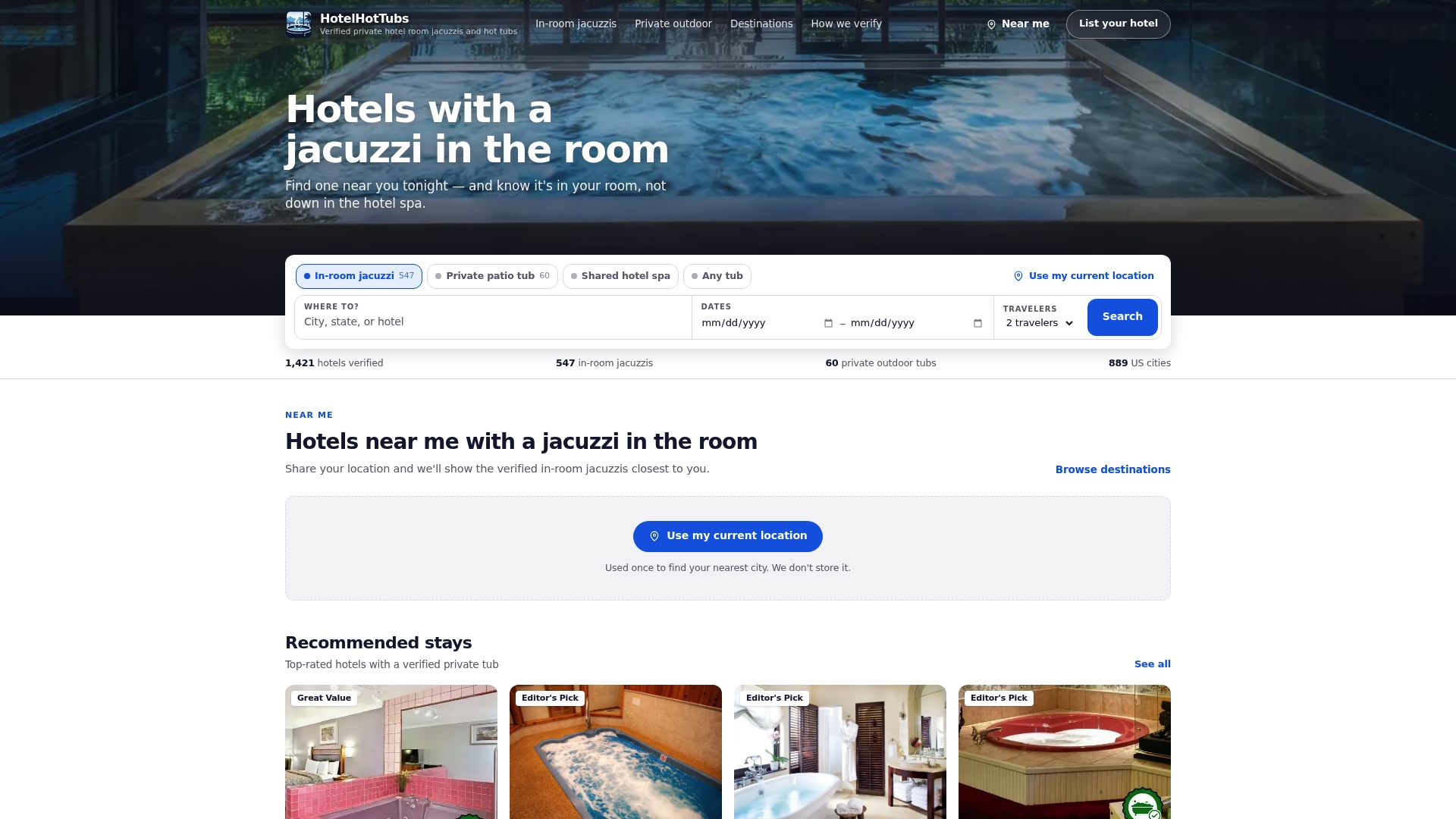
Start with hotels with a jacuzzi in the room for the broadest search, or narrow it down with whirlpool suites or hotels with a private hot tub if you want a specific setup. Run the 60-second checklist from earlier in this guide once you've picked a property, and you'll walk into your room already knowing what to expect.
This article is general information, not a substitute for advice from a qualified doctor. Consult a qualified healthcare professional about your own circumstances before acting on anything here.
Sources
FAQ
Is there such a thing as a one-person hot tub?
Yes, smaller two-person or single-occupancy hot tubs exist and are common in boutique hotel rooms and some private cabins. They're built the same way as larger tubs, just sized down, and the same CDC temperature and disinfectant guidance applies regardless of size.
What should solo travelers know about destination safety?
Safety concerns vary widely by destination and depend more on local conditions than on hot tub availability specifically. General travel safety guidance from official government sources and destination-specific advisories are the most reliable starting point before booking any solo trip.
How do I choose a hotel or service that works well for solo travelers?
Look for properties or platforms that clearly verify amenities like private tubs rather than relying on vague marketing language. Hotel Hot Tubs, for example, confirms the exact tub location for each listing using photo or review evidence before it's included in the directory.
Can a woman travel solo comfortably?
Yes, solo travel is common and manageable for women with the right preparation, including choosing accommodations with verified privacy features like in-room tubs over shared spa spaces. Checking reviews for mentions of other solo guests and confirming security details like locks and ground-floor access helps make the stay more comfortable.