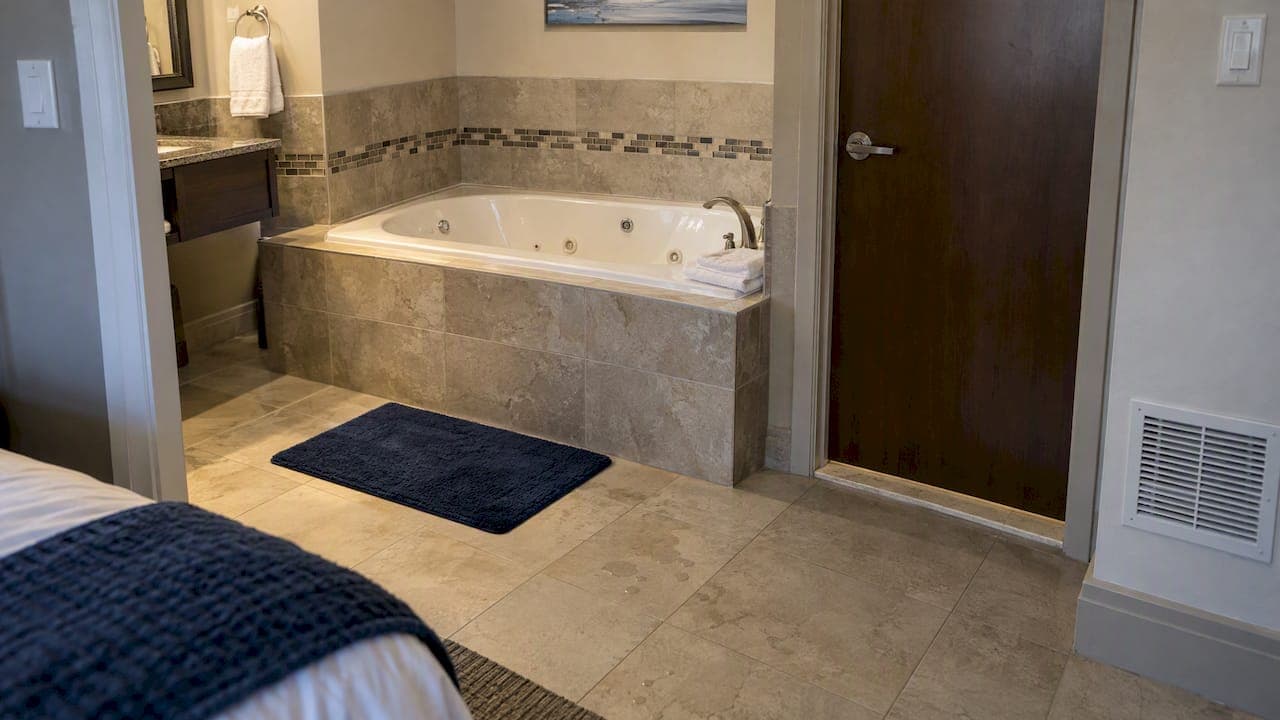
No hotel jacuzzi room is truly soundproof, and any listing that promises it deserves a question. What you can do is choose a room that is far more likely to be quiet: the right floor, the right wall, a tub with its own enclosure, and a front desk that has confirmed the details in writing. This guide explains where jacuzzi noise comes from, what builders can and cannot fix, and how to screen a hotel before you pay.
It also covers the other half of the problem. Many people searching this phrase want privacy for themselves (a tub nobody can overhear) and some want to avoid hearing someone else's tub through the wall. The checklist below handles both.
TL;DR
- "Soundproof" is a marketing word. Rooms are quieter or louder, and the weak points are usually doors, windows, vents and the pump's vibration, not the walls.
- Jacuzzi noise comes from three sources: the pump motor, water and jets, and vibration traveling through the floor and plumbing.
- Ask for a corner room, a top floor or a ground-floor room away from the elevator, and confirm in writing. Ask whether the tub is a true in-room tub, since a shared spa behaves very differently.
- A private outdoor tub on a patio is often the easiest way to get privacy, because the noise goes outdoors rather than into the next suite.
- Never trade safety for quiet. Water should stay at or below 104°F, and the room still needs real ventilation.
Table of Contents
- Why no jacuzzi room is fully soundproof
- Where jacuzzi noise actually comes from
- What actually reduces noise (and what doesn't)
- Quiet does not mean sealed: the ventilation catch
- Our perspective: verify the tub first, then chase quiet
- How to choose a quieter jacuzzi room, step by step
- Room types ranked by likely noise
- Bring your own quiet
- Find a verified in-room tub
- FAQ
- Sources
Why no jacuzzi room is fully soundproof
An EPA noise guide describes a new apartment building advertised with "revolutionary soundproofing" that turned out noisier than some old tenements. The load-bearing walls had a 62 STC rating, while the other walls were rated 35 and poorly designed. The lesson applies to hotels. A wall can have a high sound rating on paper and still let noise through, because the weak links are the doors, windows and seals around them.
A jacuzzi room has more weak links than a normal room. It has a motor, moving water, a drain, a vent fan and often a door between the bath area and the bedroom that doesn't close fully. A hotel can reduce these, but it cannot erase them. So the honest question is never "is it soundproof?" It is "how much sound reaches the next room, and how much does the room hide?"
Where jacuzzi noise actually comes from
Knowing the source tells you what to ask.
The pump and motor
The pump produces a steady hum, usually low-pitched. Low-pitched sound is the hardest kind to absorb. According to EPA guidance, soft materials such as thick carpet and draperies can cut high-pitched noise in a room by 5 to 10 dB, but only about 2 to 3 dB for low-pitched sounds. That is why a carpeted suite with heavy curtains can still hum.
Water, air and jets
Turning on the jets adds splashing, gurgling and the sound of air being pushed through the system. This is the part you hear in the room itself, and it carries through a bathroom door with a gap beneath it. Filling the tub makes noise too, and so does draining, which often runs through pipes shared with neighboring rooms.

Vibration through the structure
This is the sneaky one. Even a well-built enclosure fails if the pump touches the enclosure or the floor without rubber or neoprene damping, because the structure then carries the vibration into the building. People who have fought hot tub noise at home say the same thing: vibration is often the real cause, and mounting pumps on absorbing pads helps. In a hotel, you can't inspect the mounting, but you can avoid sleeping directly above or below another tub's equipment.

What actually reduces noise (and what doesn't)
There is a distinction that explains most disappointing hotel rooms. Sound-absorbing materials, such as carpet, acoustic tiles and heavy drapes, reduce echo and noise inside a room. They are generally ineffective at stopping sound traveling between rooms. Stopping transmission needs mass, airtight seals and structural decoupling, according to the same EPA material.
| Measure | What it does | Realistic effect for a hotel guest |
|---|---|---|
| Carpet, drapes, upholstered headboard | Reduces echo inside the room | Makes the room feel calmer, barely blocks the next room |
| Solid door with a seal and bottom sweep | Blocks airborne sound at a common leak | Often the biggest cheap improvement |
| Sealed bath enclosure | Contains pump and jet noise near the source | Strong if the enclosure is massive and airtight |
| Vibration pads under pump | Stops structure-borne hum | Invisible to you, but explains why some rooms are silent |
| White noise or fan | Masks leftover sound | Practical tool you control |
For serious reductions, the EPA recommends total enclosures with massive, airtight walls lined with sound-absorbent material inside. Those can exceed 15 dB of reduction, while well-built partial barriers deliver roughly 10 to 15 dB. The EPA also notes that if you can only treat a limited area, the upper corners where the ceiling meets two walls are the most effective spots for absorbing material.
The Department of Energy makes a parallel point about insulation. It works for sound much like it works for heat, by trapping still air, but only when it sits inside a continuous airtight barrier. If air can move through it, performance drops sharply. That's why a hotel's air sealing around plumbing, vents and door frames matters more than how thick the walls feel.
Spas that build private bath rooms face the same constraints. A good example is a Singapore wellness house offering private Hinoki onsen baths and steam rooms, where the enclosed room itself is what makes the experience feel private.
Quiet does not mean sealed: the ventilation catch
It is tempting to want the tightest possible room. But a jacuzzi room needs air handling. The CDC explains that hot tubs keep water in the temperature range where Legionella grows best (77 to 113°F) and also create aerosols. Those conditions are why design and ventilation matter. A room that is sealed for sound but has no working vent or dehumidification is a worse room, not a better one.
The same CDC page says hot tubs should never exceed 104°F (40°C). If a hotel brags about a tub that runs hotter to feel "more luxurious," that is not a feature. Our guide on hotel jacuzzi temperature explains how to check, and our 60-second cleanliness check covers what to look and smell for when you walk in. If you're pregnant, read the pregnancy safety guide and speak with your OB-GYN or midwife before using any hot tub.
Our perspective: verify the tub first, then chase quiet
We run a directory of US hotels with in-room jacuzzis and private hot tubs, and we've learned that most disappointment begins before noise does. The tub turns out to be a shared spa down the hall, or a pool-area whirlpool, not a tub in the room. A guest who expected privacy and quiet gets neither.
That's why our first job is to verify where the tub is: in the room, private, or shared, with photo or review evidence and a label showing how we verified it. We don't publish unverified claims. We don't currently rate rooms for sound, and we won't pretend a listing is soundproof. What we can tell you is that a verified in-room tub or private outdoor tub changes the noise picture in your favor, because you control when it runs and nobody walks past your door to use it.
Our advice is to treat quiet as a set of small choices: a room location, a confirmed tub type, a time of day, and a back-up plan like a white noise app. Stack them and you get a night that feels soundproof, even if no engineer would call it that.
— Logan Oneal
How to choose a quieter jacuzzi room, step by step
- Confirm the tub is in the room. Our guide to in-room jacuzzi versus spa listings shows how to read a listing. A tub in a shared spa area means footsteps and voices near your door.
- Read recent reviews for the words "noise," "thin walls," "hum" and "pump." A few mentions in a year of reviews may be fine. A pattern is a warning.
- Pick the location, not just the room type. Hotel guides on requesting quiet rooms advise identifying likely noise sources and asking for a location that avoids them, then confirming the request with the hotel directly before arrival. Avoid rooms next to elevators, ice machines, stairwells, laundry and the lobby.
- Ask about adjoining rooms. Connecting doors leak sound. Ask for a room without one, or ask whether your neighbor's unit also has a tub on the shared wall.
- Ask about the tub's hours and pump. Some properties limit jet use late at night. Ask if there is a quiet hours policy.
- Get the answer in writing. A phone promise at 4 p.m. doesn't help the night clerk at 11 p.m.
Questions worth asking the front desk
- Is the tub inside the sleeping area, behind a door, or on a patio?
- Is the room above or below another jacuzzi room?
- Does the bathroom door close fully and seal?
- Is there a ventilation fan, and does it work quietly?
- Are there quiet hours for tub use?
Room types ranked by likely noise
These are our practical tendencies, not guarantees, and they vary by building.
- Private outdoor hot tub or patio tub. The pump noise mostly goes outdoors, and you're away from neighbors' walls. Browse hotels with a private hot tub. Outdoor tubs can still be overheard by adjacent patios, so ask how they're screened.
- Suites with a tub behind its own door. A separate bath area adds a barrier. See our jacuzzi suites and whirlpool suites.
- Tub in the open bedroom. Romantic, but you hear everything and so does the room next door. Many romantic hotels with a jacuzzi in the room use this layout, so ask about the walls.
- Older motels with a tub. Often good value, but building age may mean thin partitions. Check motels with a jacuzzi in the room and read recent reviews carefully.
Bring your own quiet
Whatever room you get, a few habits help.
- Run the tub earlier in the evening, before your neighbors go to bed, and be considerate about jets and draining late at night.
- Close the bathroom door and stuff a rolled towel against the gap at the bottom to reduce leakage.
- Pack a small white noise machine or use a phone app to mask low hums.
- Use the carpet and curtains. They won't stop the neighbor, but they take the edge off echoes in your own room.
- Ask for another room within the first hour if it's noisy. Hotels move guests more easily before the night is under way.
If you're staying on a budget, noise is one more reason to compare carefully rather than pick the cheapest. Our page of cheap hotels with a jacuzzi in the room under $250 lets you filter by price and read guest feedback side by side.
Find a verified in-room tub
If you want a room where the tub is genuinely yours, start with our directory of hotels with a jacuzzi in the room. Every listing shows whether the tub is in the room, private, or shared, with the source of that verification labeled. Filter by price, location, chain, reviews and trip type, then use the questions above to check noise with the hotel before you book. If you want a private setup outdoors, try our private hot tub hotels. When you click through to book, you complete the reservation on a booking site, and we may earn a commission.
FAQ
Are jacuzzis noisy?
Most are audible. The pump hums, the jets splash and the drain gurgles, and the low-pitched hum is hard to absorb. A well-installed tub with vibration damping and a sealed enclosure can be quiet from the next room, but you can't count on it without checking.
Can a hotel make a jacuzzi room soundproof?
Not completely. Hotels can reduce noise with massive airtight walls, solid sealed doors, enclosed pumps and vibration pads, but doors, windows and vents remain leaks. Treat "soundproof" in a listing as a claim to confirm, not a fact.
How do I ask for a quiet jacuzzi room?
Call the hotel after booking and ask for a specific location: away from elevators, ice machines and connecting doors, ideally on a top or end-of-hall room. Ask whether the room sits above or below another tub, and ask them to note the request on your reservation and confirm by email.
Is a private outdoor hot tub quieter than an in-room tub?
Often, yes for your neighbors, because the pump and splashing noise goes outdoors rather than through shared walls. You may hear adjacent patios instead, so ask how the tubs are separated or screened.
Does a quiet room mean I should seal the room tightly?
No. A jacuzzi room needs working ventilation and dehumidification, because hot tubs create aerosols that can carry germs such as Legionella. Quiet should never come at the cost of fresh air.
Sources
- Quieting in the Home, US EPA
- Noise Facts Digest, US EPA
- Controlling Legionella in Hot Tubs, CDC
- How to Request a Quiet Hotel Room That Is Actually Quiet, HotelInfo.com