
Most hotels do not charge a separate deposit just because your room has a jacuzzi. What you usually see is the hotel's standard incidental or security hold, often $100 to $500 depending on the property and room type, placed on your card at check-in and released after checkout if the room is in good shape. Some properties do attach a specific deposit to their hot tub suites, so confirm the amount, timing and release process before you pay.
Below you will find the difference between a booking deposit and a security hold, real examples from US hotels, how long a release takes, and a short checklist to use before you reserve a room with a private tub.
TL;DR
- A security deposit is normally a temporary card hold, not a charge. A booking deposit is an advance payment that confirms your reservation.
- Security deposits usually range from $100 to $500, scaling with the hotel's level and room type.
- Some hotels name a jacuzzi suite deposit outright. One Texas property lists a refundable $100 incidental deposit for its king jacuzzi suite.
- Release can take days. Marriott says a bank may hold funds for up to five business days after departure.
- Read the deposit terms (amount, timing, release) on the booking page before you pay, and use a physical card in your own name.
Table of Contents
- What a jacuzzi room deposit actually is
- Booking deposit, security hold, damage fee: three different things
- What hotels actually hold: real examples
- How long until you get it back
- Credit card or debit card?
- How to avoid a deposit surprise
- Questions to ask before you reserve a tub room
- Perspective
- Find a verified in-room jacuzzi, then check the terms
- FAQ
- Sources
What a jacuzzi room deposit actually is
People search this phrase for two different things. Some mean the money a hotel takes to secure the reservation. Others mean the extra hold a hotel places because the room has a tub, a whirlpool or a private spa. Both exist, and they work differently.
A hotel deposit in the general sense is an upfront payment that secures a reservation and protects the hotel against cancellations, damages or incidental charges. With a jacuzzi room, that protection matters to the hotel for a plain reason: a room with plumbing, jets and heaters has more that can go wrong than a standard king.
At check-in, the hotel typically asks for a card. Marriott explains that the issuing bank places a hold covering room and tax, applicable resort fees and incidentals, and that guests are liable for room damage and smoking-related deep-cleaning fees. That is the pattern across most US brands, and it applies whether your room has a jacuzzi or not.

Booking deposit, security hold, damage fee: three different things
The wording on a confirmation email can blur these together. They behave very differently on your statement.
| What it is | When it happens | Do you get it back? | |
|---|---|---|---|
| Booking deposit | Advance payment that confirms the reservation | When you reserve | Depends on the rate and cancellation window; often forfeited if you cancel late |
| Prepaid or nonrefundable rate | Full stay charged up front | At booking | Generally no |
| Security or incidental hold | Funds blocked on your card as a safety net | At check-in | Yes, released after checkout if no issues |
| Cash security deposit | Cash handed over at the desk, where accepted | At check-in | Yes, returned after inspection, sometimes by check |
| Damage fee | Final charge for actual damage | After checkout | No, it is a real charge |
A useful way to read this: a refundable security deposit is a temporary hold that is returned if no issues occur, while a nonrefundable booking deposit is typically forfeited if you cancel outside the allowed windows. Hilton makes the same split on its own payment page: nonrefundable or advance-purchase rates are charged immediately for the full stay, while an incidental hold is released within 72 hours after checkout, although your card provider may take longer.
The damage fee is the one to keep in mind with a tub. Industry guidance stresses that a refundable deposit is a temporary hold, whereas a damage fee is a finalized charge for actual damage. Overflowing water, spilled bath products or smoking in the room are the sort of things that turn a hold into a charge.
What hotels actually hold: real examples
Amounts differ by property, so here are published figures instead of a guess.
- A jacuzzi-specific deposit. The Grand Texan Hotel requires a refundable $100 incidental deposit for its king jacuzzi suite.
- A standard authorization. Residence Inn St. Louis Downtown processes a $150 authorization for incidentals at check-in.
- A resort deposit with an alternative. The Breakers Resort in Myrtle Beach requires a refundable $100 security deposit at check-in. Guests may instead buy its nonrefundable Worry Free Vacation option for $49.99 plus tax, which covers up to $1,000 in non-negligent or accidental damage.
- Cash deposits. Where hotels accept them, cash deposits are often $50 to $200 or more per stay, and some properties set them higher than a typical card hold.
The pattern: a hold of about $100 to $150 is common at midscale properties, and higher-end resorts and suites can sit toward the top of the $100 to $500 range. Marriott adds that the daily incidental amount may vary by location, so even within one brand you cannot assume a single number.
Why a tub room can differ from a standard room
The same industry guide that gives the $100 to $500 range says amounts often scale with the property's luxury level and the specific room type booked. A suite with an in-room spa is a different room type from a standard double, so it is reasonable to expect the hold to be at or above the property's usual figure. Whether it is higher is the hotel's call, which is why the next step is to read the terms for your exact room rather than the hotel's general page.
How long until you get it back
Release is not instant, and this is where most surprise comes from. The sequence is simple: you check out, housekeeping inspects, the hotel releases the hold, and your bank then makes the funds available again.
- Inspection. Housekeeping inspections take place after check-out to verify room condition before the final release of a hold is authorized.
- Hotel release. Deposits are generally refunded or released once no damages or outstanding incidental charges are found.
- Bank release. Marriott notes that the issuing bank may not release the hold for up to five business days after departure.
Cash and check refunds are slower. The Breakers says its $100 deposit is refundable after checkout minus applicable incidental charges, and refundable cash deposits are issued by check within 7 to 10 business days.
So if you are planning a weekend away, assume the money could be tied up for up to a week after you leave, and plan your budget around that.
Credit card or debit card?
The card you hand over changes how a hold feels. A credit card hold reduces your available credit. A debit card hold freezes actual cash in your checking account, which can cause overdraft problems if your balance is low. If you have a choice, a credit card is the easier way to carry a hold for a few days.
Also check what the hotel accepts. Some properties may reject virtual cards, digital wallets or third-party payment forms for security deposits and require a physical credit or debit card matching the guest's name and identification. A phone wallet that worked fine for the room rate may not work at the front desk.

How to avoid a deposit surprise
You cannot usually skip a deposit, but you can remove the surprise. Here is the order we would follow.
- Read the deposit terms before you pay. Check the amount, the timing and the release process, because policies vary by property. Look at the room-level page for the tub suite, not only the hotel's general policy.
- Separate the booking deposit from the check-in hold. Know what is charged now, what is held later and which part is refundable.
- Ask whether an alternative exists. Some resorts offer an accidental damage option in place of a refundable deposit, as the Breakers example shows. If a hotel offers one, read what it covers before you decide.
- Match the card to the name. Bring the physical card that matches your ID.
- Keep your balance in mind. Leave room for a hold of several hundred dollars plus the room rate, especially on a debit card.
- Keep the paperwork. Save the confirmation, the policy page and any photos of the room and tub at check-in, so any later dispute rests on records.
For the money side of the same topic, our guide to jacuzzi room fees and the FTC rule on up-front total pricing explains what should be shown to you before you book, and booking verified jacuzzi suites to avoid deposit surprises covers the planning side in more depth.
Questions to ask before you reserve a tub room
A short call or email saves hours later. Ask:
- What is the exact deposit or incidental hold for this room type, and is it charged or only authorized?
- When is it released, and does the hotel release it before the bank does?
- Is there a cleaning or usage fee for the jacuzzi, separate from the deposit?
- What does the cancellation policy say about the booking deposit? If plans change, our guide to jacuzzi suite cancellation policies, fees and your rights walks through the options.
- Is the tub in the room, on a private balcony or shared? Confirm the location in writing.
That last point matters more than it sounds. A deposit is a small cost compared with arriving to find a shared spa instead of the private tub you booked.
Perspective
Travelers rarely get burned by the deposit itself. They get burned by not knowing what it was for. A hold of $100 to $200 is normal and returns to your card. What hurts is paying for a room you thought had a private tub and finding something else.
That is why we focus on one question first: where exactly is the tub? Every listing on our site is checked for tub location, in-room, private or shared, with photo or review evidence, and we label the source of that verification. We do not publish claims we cannot back.
Once you know the tub is truly yours, the deposit becomes simple arithmetic. Read the terms for your room, plan for the hold to stay on your card for up to a week, use a credit card if you can, and enjoy the stay. We built the directory so you can spend your time on that last part.
Logan Oneal
Find a verified in-room jacuzzi, then check the terms
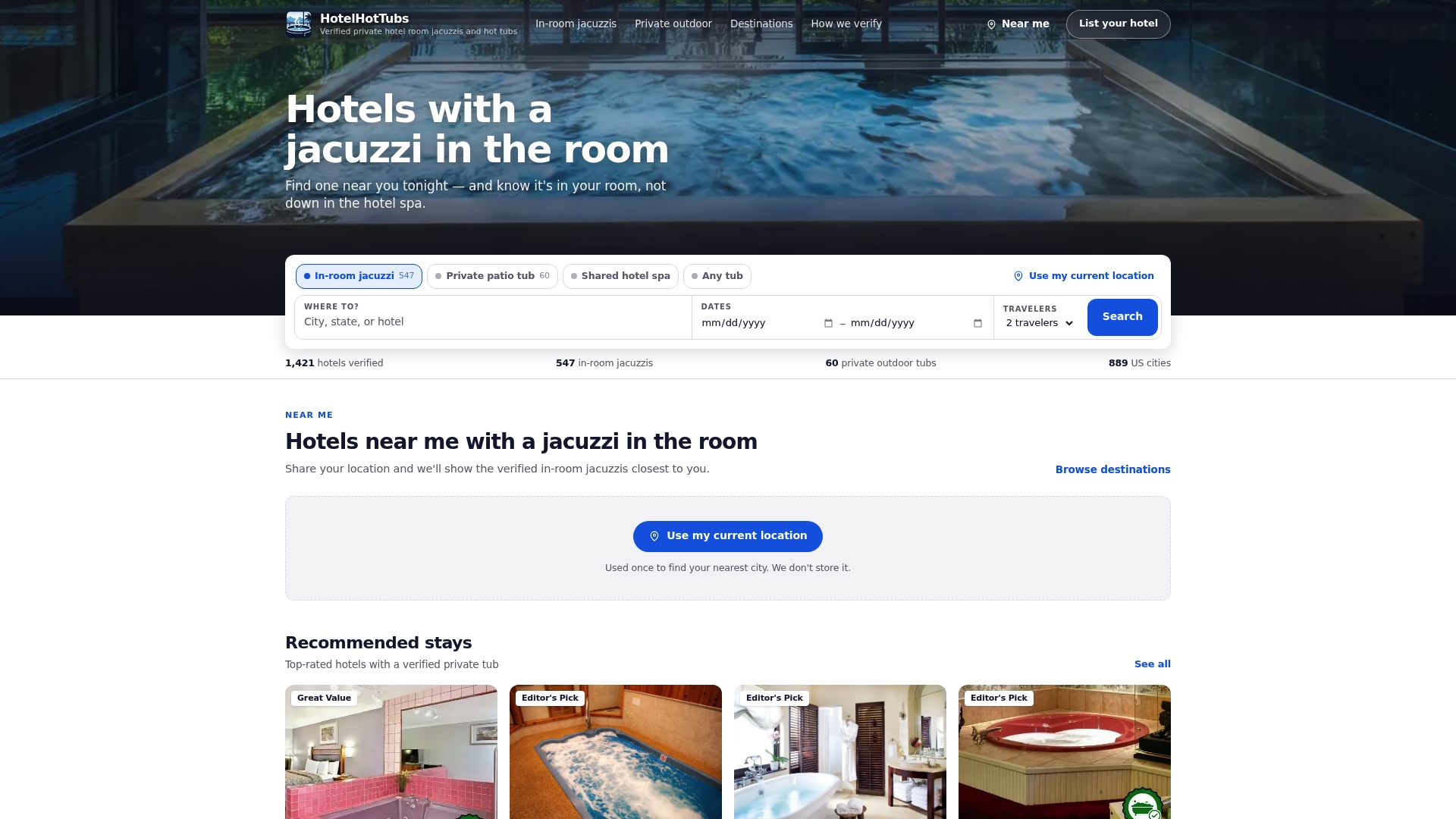
If you are still choosing a hotel, start with the room, then confirm the deposit on the booking page. Our directory of hotels with a jacuzzi in the room lets you filter by price, location, chain, reviews and trip type, with verified amenity photos and guest testimonials.
Watching your budget? Browse cheap hotels with a jacuzzi in the room under $250. Planning a couple's trip? See romantic hotels with a jacuzzi in the room. Want more space? Try our jacuzzi suites. Deposit amounts and terms are set by each hotel and its booking site, so confirm them on the page where you reserve.
FAQ
What is a security deposit at a hotel?
It is a temporary hold or payment that protects the hotel against damage, unpaid incidentals and similar costs. At most US hotels it appears as an authorization on your card at check-in, and it is released after checkout once the room is inspected and no extra charges are found.
Do hotels charge more of a deposit for a jacuzzi room?
Some do and some do not. The Grand Texan Hotel, for example, lists a refundable $100 incidental deposit for its king jacuzzi suite, while many hotels apply one standard hold to every room. Because amounts often scale with room type, check the terms for the specific suite you are booking.
How do I avoid a hotel security deposit?
Usually you cannot skip it, but you can sometimes swap it. A few resorts offer a paid damage-protection option instead of a refundable deposit, such as the $49.99 plus tax option at The Breakers. Otherwise, use a credit card so the hold reduces credit rather than tying up cash, and ask the hotel what it accepts.
How long does it take to get a hotel deposit back?
Hilton says its incidental hold is released within 72 hours after checkout, though a card provider may take longer. Marriott notes banks may take up to five business days. Cash deposits refunded by check can take 7 to 10 business days at some properties.
Is a booking deposit the same as a security deposit?
No. A booking deposit is paid in advance to confirm the reservation and may be forfeited if you cancel late. A security deposit is a refundable safety net taken at check-in. Read both in your confirmation so you know which is which.
Sources
- Marriott: Digital Entry Terms of Use
- Mews: Hotel Deposit & Security Hold Policy Guide
- ProStay: Hotel Deposit Policies guide
- Grand Texan Hotel: King Jacuzzi Suite
- Residence Inn St. Louis Downtown: Rooms & Suites
- The Breakers Myrtle Beach Resort: FAQ
- Hilton Honors: Payment Email FAQs
- Belamere Suites: Reservations
- LegalClarity: Do You Get Your Hotel Deposit Back?
- RoomMaster: Hotel Damage Fees guide