
The fastest way to read jacuzzi room reviews is to stop reading hotel reviews in general. Filter for the tub itself, sort by newest, read guest photos before hotel photos, and look for the same tub complaint repeated by several guests. A single glowing or furious comment tells you little. A pattern tells you almost everything. And a review only helps if it describes the exact room you plan to book, which is why every listing at Hotel Hot Tubs labels where the tub is and how that was verified.
TL;DR
- Search reviews for tub words ("jacuzzi," "jets," "whirlpool," "hot tub") and read the newest ones first, not the highest-rated.
- One complaint is noise. Several recent guests describing the same problem (cloudy water, dead jets, lukewarm refills) is a pattern.
- Guest photos beat hotel photos. Check the tub's location, the jets, the caulk and the water.
- Confirm the review is about your room type: in-room, private balcony or shared spa are very different stays.
- On a budget under $250, weigh the tub reviews against fees and room type, not the nightly rate alone.
Table of Contents
- Why jacuzzi room reviews are harder to read than ordinary hotel reviews
- Step 1: Search the reviews for the tub, not the hotel
- Step 2: Sort by newest and read the recent pile
- Step 3: Look for patterns, not outliers
- Step 4: Know the cleanliness red flags
- Step 5: Trust guest photos over hotel photos
- Step 6: Separate genuine reviews from suspicious ones
- Step 7: Check that the review is about a private tub in your room
- Step 8: Read for your kind of trip
- Step 9: Make the call when reviews are not enough
- Reading reviews on a budget: jacuzzi rooms under $250
- Our perspective
- Find a jacuzzi room whose tub is already verified
- A quick checklist to use on any listing
- FAQ
- Sources
Why jacuzzi room reviews are harder to read than ordinary hotel reviews
Most hotel reviews are about beds, breakfast and location. A jacuzzi room adds a single feature that can make or ruin the whole stay, and it is often buried in a review about something else. A guest writes "great stay, would return" and never mentions that the jets were off. Another leaves one star because the tub took forty minutes to fill, and the same sentence shows up nowhere else.
There is also a labeling problem. "Jacuzzi" is used loosely. It can mean a jetted whirlpool tub in the bedroom, an oversized soaking tub with no jets, a private outdoor tub on a patio, or a shared hot tub down the hall. Reviewers use the words interchangeably, so a four-star review that praises "the jacuzzi" may be praising the pool-area spa. Our guide to whirlpool versus jacuzzi checks explains the naming differences, and the jetted versus soaking tub checks show how to tell them apart from a room description.
That is the first rule of reading these reviews: work out which tub the reviewer actually used before you let their rating move you.
Step 1: Search the reviews for the tub, not the hotel
Open the reviews and use the search box if the platform has one. Try each of these words in turn, because guests do not agree on a name:
- jacuzzi
- hot tub
- whirlpool
- jets
- spa tub or jetted tub
Then add words that describe the experience: "clean," "cloudy," "lukewarm," "loud," "small," "drain." If a hotel has hundreds of reviews and only two mention the tub, that tells you something too: the tub may be a minor feature of the property, or the room type you want is rarely booked.
When you find tub reviews, read what room the guest stayed in. Reviewers often name the room type ("king suite," "room 214," "spa suite") and the tub's location (bedroom, bathroom, balcony). A review that names the room is far more useful than one that does not.
Step 2: Sort by newest and read the recent pile
A tub that was spotless in 2022 can be neglected now. Hotel renovations, new management and deferred maintenance all change a room quickly, so the age of a review matters as much as its content.
Sort by newest rather than by rating. A reasonable working window is the last few months, with a quick look at the past year to see whether the tub has been stable. Aim for roughly the most recent 20 to 30 reviews across more than one platform. Several travel guides recommend this approach, including a pre-arrival research framework that suggests sorting by date to see whether a property has declined or changed its amenities.
For a jacuzzi room, apply that window to the tub specifically. If the three most recent reviews that mention the tub all say it worked well and was clean, that is stronger evidence than a 4.6 average built over five years.
Step 3: Look for patterns, not outliers
The single most useful habit is counting. Guests disagree about decor, music and breakfast. They rarely disagree about whether a tub drains or heats.
| What you see | What it likely means |
|---|---|
| One guest says the jets were weak | Possibly one unlucky room or one picky guest |
| Three guests in a few months say the jets barely work | A maintenance problem the hotel has not fixed |
| Five-star and one-star reviews with nothing in between | Inconsistent rooms or inconsistent management |
| Mostly four-star reviews with a few three-star notes | Usually a steady, honest picture |
| Same complaint, different years | A long-running issue |
| Same complaint, only from one month | Possibly a temporary repair that is now fixed |
Travel writers make the same point in plain terms: one bad review is noise, but several recent reviews repeating the same issue is signal. Give extra weight to maintenance complaints. Repeated mentions of slow hot water, noisy plumbing or mold affect comfort directly, whereas a guest who dislikes the wallpaper is giving an opinion. Maintenance complaints matter more than isolated style opinions, and that holds doubly when the thing being maintained is something you will sit in.
Step 4: Know the cleanliness red flags
This is where reading carefully protects your health, not just your evening. Hot water that is not properly disinfected can carry bacteria. The CDC notes that hotels and resorts are frequent settings for Legionnaires' disease outbreaks, and that regular hot tub maintenance is key to preventing the spread of Legionella. You cannot smell or taste the bacteria, so reviews and your own eyes are the best early warning you have.
In a March 2026 Travel + Leisure article, trial attorney Eric Shane, who has represented families affected by Legionnaires' disease linked to hotel water systems, lists cloudy, murky or foamy water, visible algae or biofilm around the jets, and jets that do not work properly as red flags. He also notes that Legionella is odorless and tasteless, so there is no easy tell-tale sign.
Translate that into review reading. Pay attention when guests mention:
- Cloudy, foamy or discolored water
- A film, slime or debris coming out of the jets
- Hair or residue in the tub on arrival
- Jets that sputtered, stayed off or blew lukewarm air
- A musty or chemical smell in the bathroom
- Staff who did not know how to run or drain the tub
Those details are specific, and specific is good. A review that says "jets blew out gray flakes when I turned them on" deserves more weight than ten that say "nice room."
People at higher risk from Legionella, including older adults and people with weakened immune systems or chronic lung disease, should be especially careful with any shared or poorly maintained hot water feature and can ask their doctor whether a jetted tub is right for them. If you have a specific health condition, your doctor is the person to ask, not a review.
Our own 60-second jacuzzi check walks through what to look at in the room, and there is a short guide on how to clean a hotel jetted tub before you use it.
Step 5: Trust guest photos over hotel photos
Hotel photos are professionally lit and chosen to sell. Guest photos are unflattering and accurate. One travel team puts it this way: guest-uploaded photos are where you find the truth about a bathroom, because that is where corners tend to get cut.
When you scroll through guest photos of a jacuzzi room, look at:
- Location. Is the tub in the bedroom, in the bathroom or on a balcony? Is it the one in your room category?
- The jets. Can you see round jet nozzles on the walls of the tub? A smooth tub with no nozzles is a soaking tub.
- Condition. Look for discolored grout, chipped enamel, yellowed caulk and stained jets.
- Water level and clarity. Photos taken with water in the tub tell you more than empty ones.
- Privacy. For a balcony or patio tub, look for fencing, walls or sightlines to neighbors.
- Scale. A small bathroom with a corner tub is not a spa suite. See whether there is shelf space, a ledge for drinks and adequate lighting.
When the photos match the description and several different guests uploaded similar shots from the same room type, that is a good sign.
Step 6: Separate genuine reviews from suspicious ones
The Federal Trade Commission's rule on consumer reviews and testimonials went into effect on October 21, 2024 and targets fake or deceptive reviews. The rule does not make every review trustworthy, though, so a sharp eye still helps. Warning signs include:
- Generic enthusiasm with no specifics ("Amazing! Perfect! Loved it!")
- Repeated praise of the hotel name or brand
- Reviewer profiles with a single review
- A burst of similarly worded five-star reviews within a few days
These are the tells that review-reading guides commonly list for fakes. The better reviews contain concrete details, such as the room type, the date of stay, how long check-in took or whether parking was easy. A reviewer who tells you the tub took ten minutes to fill and the water stayed hot is describing something you can check against other reviews.
A mixed profile can also be a good sign. A property with mostly four-star reviews and a handful of three-star comments is often a safer bet than one with a cluster of five-star and one-star reviews, which suggest wildly inconsistent experiences.
Step 7: Check that the review is about a private tub in your room
This is the step most generic hotel sites skip. A hotel may have a jacuzzi in some rooms, a shared spa by the pool and a standard room with a regular tub. Reviews mix them all together.
Before a review counts for your decision, ask three questions:
- Does the reviewer say they used the tub in their room, or the hotel's spa?
- Is it the same room type as the one you are booking?
- Is the tub described as jetted (whirlpool) or only as a large bath?
Room descriptions help too. Good ones specify the tub type, its location and its size. If a listing only says "spa bath," that could mean jets or just a deep tub, and that is worth settling before you pay.
This is the problem we built Hotel Hot Tubs to solve. Each listing states whether the tub is in the room, private or shared, with photo or review evidence and a label showing how it was verified, so you are not left reconciling a hotel's marketing with a reviewer's loose use of the word "jacuzzi."
Step 8: Read for your kind of trip
The same review can be a green light for one traveler and a warning for another.
Couples. Look for comments about privacy, lighting, noise from neighboring rooms and whether the tub is in the bedroom or behind a closed door. Small details decide the mood: a tub under harsh light with no dimming options, or a small water heater that leaves refills lukewarm, will not feel romantic. Our romantic hotels with a jacuzzi in the room page is built around those needs.
Families. Check whether guests mention children using the tub, the water temperature, slippery floors and how the room is laid out. Scan for notes on an indoor pool nearby. Families who want both can start with hotels with an indoor pool and a hot tub in the room. Tubs are for adults to supervise closely, and hot water is not suited to young children, so ask your pediatrician about safe temperatures and time limits if you are unsure.
Business travelers. Search for "quiet," "Wi-Fi," "desk" and "late check-in" alongside the tub words. After a long day you want hot water on demand and a room you do not have to troubleshoot. Complaints about slow hot water or noisy plumbing are the ones to weigh heavily.
Anyone seeking relaxation. Read for evidence of consistency: the same positive details from different guests over several months.
Step 9: Make the call when reviews are not enough
Sometimes reviews leave a question open: the heater size, whether the jets work, whether the tub is in the room you booked. A short call to the front desk settles it. Ask which room number or type has the tub, whether it is jetted, and how it is cleaned between guests. A specific answer about a flush or disinfection routine is reassuring. A vague "we wipe it down" is thin, and some travel writers treat it as a red flag.
If you see something wrong when you arrive, such as cloudy water, residue or jets that fail, tell the front desk and ask for a different room before you use the tub. Do not get in a tub you are not comfortable with.
Reading reviews on a budget: jacuzzi rooms under $250
A lower price changes what you should hunt for in reviews. Cheap rooms with tubs can be excellent, but the savings only matter if the tub works. When you are shopping under $250 a night, weigh the following.
The tub reviews matter more than the star rating. A three-star property with consistent praise for a clean, working tub often beats a four-star property with no tub mentions at all. Search the tub words first, then glance at the overall score.
Check the room type behind the price. The cheapest listed rate is frequently the standard room. The jacuzzi suite costs more. If a review mentions the tub, confirm it is the category you are pricing.
Look for value comments. Guests who say a room was "worth it," or who mention the size of the room, breakfast included or free parking, give you a better picture of what your total cost buys.
Add up the real total. Before you decide, compare the nightly rate, any added fees and taxes shown at checkout, and parking. A worked example using made-up numbers: a room at $199 plus $30 in fees is $229 before tax, which is cheaper than a $215 room with $45 in fees ($260). The total is what you compare, not the headline rate.

Motels count. Motels with in-room tubs often fall well inside a $250 budget, and reviews tend to be blunt about condition. Browse motels with a jacuzzi in the room and read the newest reviews with the same method.
To skip the guesswork, our cheap hotels with a jacuzzi in the room under $250 page lists budget options where the tub's location has been verified, so the reviews you read are about a tub you will actually get.
Our perspective
Reviews are the best free research a traveler has, but they were never designed to answer the question a jacuzzi seeker asks: is the tub in my room, and is it private?
A review site rates hotels. It cannot easily tell you that the guest who praised "the jacuzzi" soaked in a shared spa on the ground floor while your suite has a whirlpool beside the bed. That gap is why we list only hotels with in-room or private tubs and label the location as in-room, private or shared, with the photo or review evidence behind it.
Our advice is to use both. Read recent reviews with the pattern method above, and start from listings where the tub question is already answered. Then your reading time goes to what reviews do best: telling you about cleanliness, noise and how a particular property treats its guests.
We do not publish unverified tub claims. When you click through to book, you should be booking the private jacuzzi you pictured.
Logan Oneal
Find a jacuzzi room whose tub is already verified
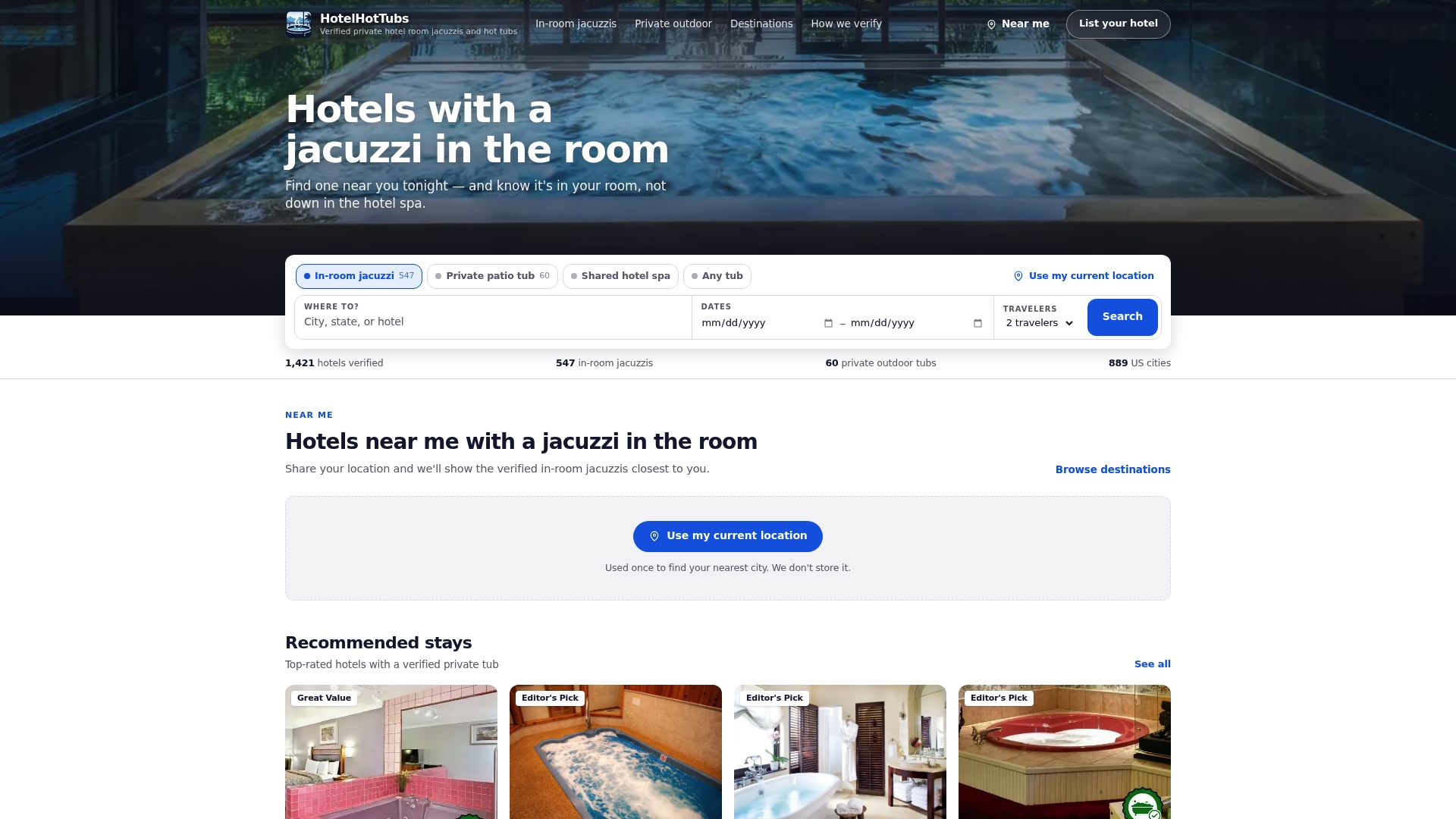
If you would rather start from a short list than from hundreds of mixed reviews, Hotel Hot Tubs is a directory of US hotels with verified in-room jacuzzis and private hot tubs. You can filter by price, location, hotel chain, reviews and trip type (romantic, family or business), and each listing shows amenity photos and guest testimonials. Prefer a private outdoor tub? Browse hotels with a private hot tub.
Related pages: whirlpool suites and jacuzzi suites cover the two room types most often described as "jacuzzi suites" in reviews. For a full walkthrough of review reading on our blog, see how to read reviews for jacuzzi rooms.
A quick checklist to use on any listing
- Search reviews for "jacuzzi," "hot tub," "whirlpool" and "jets."
- Sort by newest and read the latest 20 to 30 reviews.
- Count repeated tub complaints across different guests and months.
- Open guest photos and check the tub's location, jets and condition.
- Confirm the reviewer stayed in your room type.
- Watch for cloudy water, residue, dead jets and musty smells.
- Discount vague, repetitive or one-review profiles.
- Compare the total price, not just the nightly rate.
- Call the front desk if any answer is still open.
FAQ
How many reviews should I read before booking a jacuzzi room?
Read the most recent 20 to 30 reviews, plus every one that mentions the tub. Sorting by newest matters more than reading a large number. If fewer than a handful mention the tub, look at the photos and room description closely.
What is the biggest red flag in a jacuzzi room review?
Repeated, recent mentions of cloudy or foamy water, residue in the jets or jets that do not work. These point to cleaning or maintenance gaps. A single mention is worth noting, but several different guests describing the same thing is a pattern to take seriously.
How do I know a review is about the jacuzzi in the room and not the hotel spa?
Look for the room type or number and for words like "in our room," "in the bathroom" or "on the balcony." Guest photos help as well. If the reviewer never says where the tub was, treat the comment with caution and look for another from the same room category.
Are low-priced jacuzzi rooms usually worse in reviews?
Not necessarily. Price tells you less than recent, specific comments about the tub's cleanliness, heat and jets. A modest property with steady praise for its tub can be a better stay than a pricier one with none. Compare the total after fees, and confirm the room type behind the rate.
Can I trust a perfect five-star rating?
Be careful with ratings built on short, generic comments or a burst of near-identical reviews. A mix of mostly four- and five-star scores with a few honest three-star notes, and reviews that name specific details, usually gives a more reliable picture.
Sources
- CDC: Hospitality and Recreational Water Facilities
- Travel + Leisure: The Hidden Danger Lurking in Your Hotel Hot Tub
- FTC: The Consumer Reviews and Testimonials Rule, Questions and Answers
- How to Evaluate a Hotel Before Booking: A Pre-Arrival Research Framework
- How to Evaluate Resort Reviews Like a Pro
- How to Read Hotel Reviews Like a Local
- How to Read Resort Reviews Like a Pro
- Your Expert Guide to Hotels with Jacuzzi in Room
- What to Look For in a Hotel with a Jacuzzi