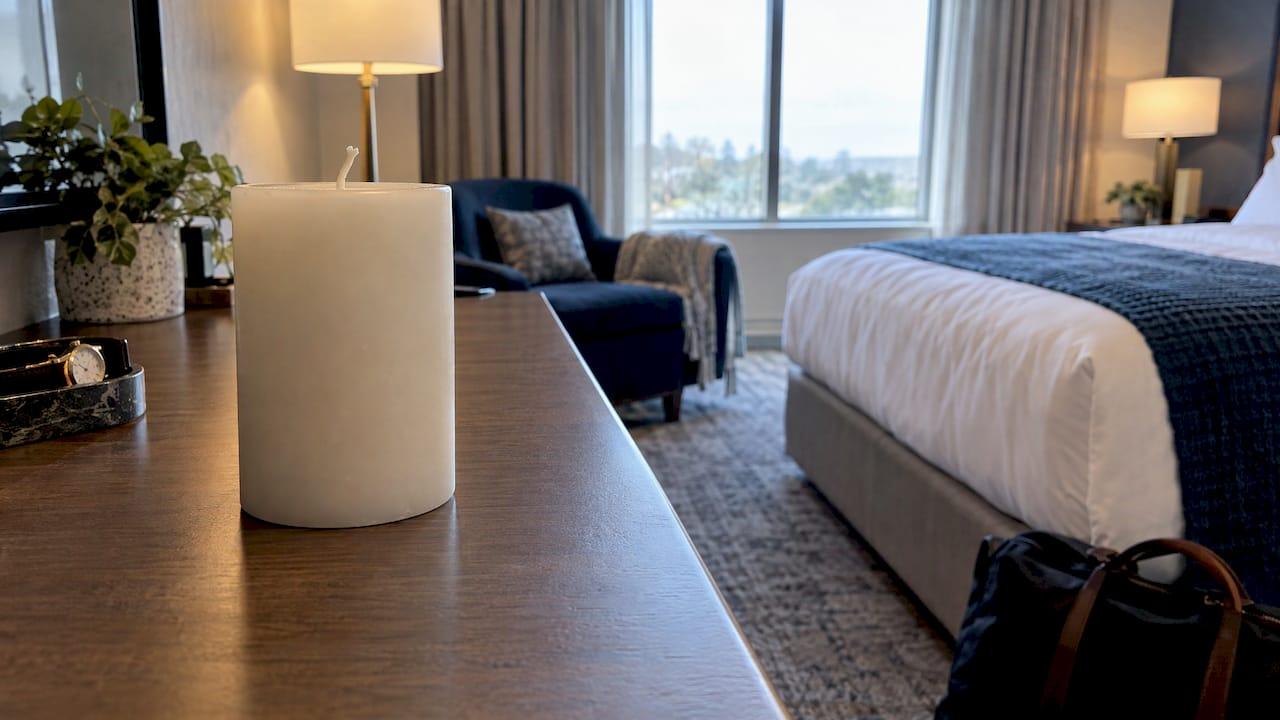
Almost every hotel says no to lit candles in guest rooms. Fire safety guidance tells lodging guests not to burn them, and many hotels print a cleaning fee in their house rules. An unlit candle for decoration is usually fine, and a battery-operated flameless candle is the safe way to get the same glow. If you are planning a romantic stay, you can get the mood without risking a fine, an alarm or an evacuation.
This guide covers what hotels actually write in their policies, why the rule exists, what can happen if a candle is lit anyway, and how to set the scene with flameless options. It also covers how to ask a hotel before you pack anything.
TL;DR
- Lit candles are not allowed in most hotel rooms. Fire safety officials say candles should not be used in hotel, motel or lodging guest rooms.
- Hotels that ban open flames often attach a fee. Published examples run from $250 to $500 for cleaning, plus damage costs.
- Bringing an unlit candle is usually tolerated, but the safest plan is to pack flameless LED candles.
- Always check the hotel's own policy page or call the front desk. Rules differ by property, not just by brand.
- Romantic mood is easy without a flame: dim lamps, LED candles, petals and a private hot tub do most of the work.
Table of Contents
- The short answer: are candles allowed in hotel rooms?
- What hotels actually write in their policies
- Why hotels restrict candles
- What happens if a candle is lit anyway
- Unlit candles and scented candles
- Flameless candles: the mood without the risk
- How to check a hotel's candle rule before you go
- Safety habits that matter wherever you stay
- Setting a romantic mood in a jacuzzi room
- Find a room with a private tub
- Our perspective
- FAQ
- Sources
The short answer: are candles allowed in hotel rooms?
No, in the large majority of cases. The Vermont State Fire Marshal's hotel and motel topic sheet states that candles should not be used in lodging guest rooms and should never be left unattended. That guidance shapes how many properties write their own rules.
In practice you will meet three kinds of policy:
- A flat ban on open flames. Candles, incense and anything that burns are prohibited in rooms and often on the whole property.
- A ban with a fee. The same ban, plus a stated charge for cleaning, odor removal or damage if staff find evidence of burning.
- A ban with a substitute. Some small inns say no to flames but supply flameless candles for a cozy evening.
You will rarely find a hotel that welcomes lit candles in guest rooms. Bed and breakfasts and cabins occasionally differ, but the rule is to ask first and never assume.
What hotels actually write in their policies
It helps to see the language. These are published house rules from real properties:
| Property | What the policy says | Stated consequence |
|---|---|---|
| theWit Hotel, Chicago | Candles are a prohibited item in guest rooms; burning is banned in a 100% smoke-free building | $500 cleaning fee; tampering with fire detection equipment leads to eviction |
| Island Hotel Collection (21 Broad Hotel and 76 Main Ink Press Hotel) | Flame-free properties: no candles or open flames in rooms or anywhere on property | $250 cleaning surcharge for open-flame use |
| Southmoreland, Kansas City, MO | Open flames of any kind, including candles and incense, are strictly prohibited in rooms | Full price for any damage, cleaning or replacement |
| Casa Sedona Inn | Open flames not permitted in guest rooms | Flameless candles are provided for guests |
Notice the pattern. The wording covers more than candles: incense and open flames of every kind. The fees are not symbolic, and one policy treats tampering with a smoke detector as grounds for eviction. If you were planning to cover a detector so a candle would not set it off, do not. That is the fastest way to turn a romantic night into a lost booking.
Why hotels restrict candles
Fire risk is real and well documented
The National Fire Protection Association reports that during 2020 to 2024, US fire departments responded to an estimated annual average of 5,894 home structure fires started by candles. Those fires caused an average of 63 civilian deaths, 532 injuries and $286 million in property damage each year.

The same NFPA page says that over half of candle fires start when something flammable is too close to the flame. In a hotel room, that means bedding, curtains, upholstered furniture, clothing and paper. Hotel rooms are built from exactly those materials, and a guest in an unfamiliar room is less likely to think about where they are.
Unattended and forgotten flames
NFPA found that in 21% of home structure candle fires, the candle was left unattended, discarded or otherwise misused. Falling asleep with a candle lit is the classic scenario, and it is more likely on vacation after a long day and a glass of wine. The US Fire Administration's candle safety page advises keeping candles at least 12 inches from anything that burns and not using lit candles in bedrooms, bathrooms or sleeping areas. A hotel suite is, by definition, a sleeping area.
Shared building, shared risk
A fire in your room is a problem for everyone on the floor. One hotel can hold hundreds of sleeping strangers, so operators and their insurers take a strict line. Some states also write sprinkler and detection requirements into law for lodging. Florida's statute, for example, requires covered lodging buildings to have sprinklers meeting NFPA 13 and guest-room smoke detection, subject to conditions on height, construction date and other factors. Hotels invest heavily in those systems and do not want them tested by a candle.
The Vermont guidance adds a quieter point: open-flame burners and hot plates in small rooms can cause nuisance alarms that lead to disconnection of life-saving devices. A disabled detector is a hazard for the next guest too.
What happens if a candle is lit anyway
Best case, nothing happens and you leave a faint smell that housekeeping notices. That is still how many guests end up with a cleaning charge on their card. The worse cases are not hypothetical.
On July 1, 2026, a candle ignited clothing in a second-floor room at a Sonesta Simply Suites in Libertyville, Illinois. The fire alarm and sprinklers activated, all three floors were evacuated, and two rooms were left uninhabitable from fire and water damage. The local fire sprinkler advisory board confirmed that the sprinklers extinguished the fire and that no injuries were reported.
That outcome is the good version. The system worked, and a whole building still lost its evening. A guest who causes an evacuation can expect a bill for damage, as the Southmoreland policy above spells out.
Smoke alarms and sprinklers
People often ask whether one small candle will set off the alarm. Sometimes it will not, and some travelers report lighting a small candle without incident. But you cannot know how sensitive a particular detector is, and blowing out several candles at once can produce a burst of smoke. Treat "it never set anything off before" as luck, not a rule, because each building, each detector and each policy is different.
Unlit candles and scented candles
The rule is about flame, not about wax. Many hotels do not object to an unlit candle sitting on the nightstand as decoration, and hotels usually do not search luggage. Still, an unlit candle invites a temptation you will not need, and some policies list candles as prohibited items outright. The theWit policy above is an example: candles are listed as prohibited in guest rooms.
If you want a scented room, there are flame-free routes:
- Essential-oil diffusers. Use only if the hotel allows plug-in devices, and keep them away from bedding.
- Room sprays and linen sprays. Spray the air, not the pillows, and ventilate afterward.
- Unlit scented candle in a sealed jar. The fragrance leaks a little even unlit, which gives a hint of scent with no risk.
Wax warmers use a heating element rather than a flame, but some hotels still ban them. Ask first.
Flameless candles: the mood without the risk
Battery-operated LED candles are the answer hotels themselves give. A hotel that bans open flames will often suggest LEDs, and some small inns provide them. They create flicker and warmth with no heat source and no smoke. Here is how to get the best from them:
- Buy ones with a flicker setting and a warm, amber light. Cool white looks clinical.
- Pack a mix of sizes. A few pillars and a handful of tea lights cover a nightstand, a tub ledge and a windowsill.
- Bring spare batteries or a rechargeable set. Hotel rooms rarely stock them.
- Choose a remote or timer. You can switch them all off from bed.
- Group them. Three to seven lights in a cluster read as a scene. One alone looks like a night light.
You can add fairy lights, a scarf draped over a lamp (kept clear of the bulb), a playlist and rose petals on the bed. Housekeeping will thank you if you bag the petals before checkout.
How to check a hotel's candle rule before you go
Policies live in a few predictable places. Work through them in this order:
- The property's own policy page. Search for "house rules" or "policies" on the hotel's site. Look for "open flame," "candles," "incense" and "smoke-free."
- The booking confirmation. Terms and fees are often repeated there.
- The front desk. Call and ask: "Are candles, including unlit ones, allowed in guest rooms, and do you provide flameless ones?" Staff answer this all the time.
- Special-occasion requests. If you are planning a proposal or anniversary, tell the hotel. Many will help you set up a safe display or point you to a policy-compliant option.
A written reply protects you if a charge shows up later. Fees tied to rules are also part of the total price of a stay, so it is worth reading our guide to jacuzzi room fees and the FTC rule on upfront pricing to know what should be disclosed before you book. For other details worth confirming, see our hot tub amenity fine print checklist.
Safety habits that matter wherever you stay
Even if you never light a candle, a few habits from the US Fire Administration are worth practicing in any hotel. Its hotel and vacation rental fire safety page advises staying in properties with hard-wired smoke alarms and an automatic sprinkler system in each guest room. It also advises reading the evacuation plan, finding the two closest exits and counting the doors between your room and those exits.
Do this on arrival, before you unpack. It takes two minutes and applies whether the cause of a fire is a candle, a faulty charger or a neighbor's room.
Setting a romantic mood in a jacuzzi room
The best flame-free atmosphere is built around the tub. A private in-room hot tub gives you warm water, steam and privacy, and lighting becomes simple: dim the overheads, line the tub ledge with LED candles and turn on a warm lamp across the room. You get the look of candlelight with none of the hazard. Keep towels, robes and bedding well away from any heat source, as always.

If you are choosing where to stay, start with our romantic hotels with a jacuzzi in the room. If the tub is the star and you want to confirm exactly what you are getting, our call script for confirming a private hotel hot tub lists what to ask. Travelers weighing a smaller soak option can read plunge pool vs. hot tub in the room.
Find a room with a private tub
At Hotel Hot Tubs we list US hotels with an in-room jacuzzi or private hot tub, and we label how each tub location was verified, whether in-room, private or shared. You can filter by price, location, hotel chain, reviews and trip type, and look at amenity photos and guest testimonials before you click through to book.
If you are planning an anniversary or a weekend away, browse hotels with a jacuzzi in the room or go straight to jacuzzi suites. On a budget, our cheap hotels with a jacuzzi in the room page is built for deals under $250.
Our perspective
We built Hotel Hot Tubs because guests kept booking a room for the romance and finding the details did not match the photos. Candles are the same kind of problem: people plan a scene, then learn the rules at check-in.
Our view is simple. The memorable part of a hotel getaway is rarely the flame. It is privacy, warm water and time with someone. A private in-room hot tub delivers all three, and you do not need an open flame to make it feel special.
That is why we verify the tub location for every stay and label the source of that verification. When you know exactly what the room has, you can plan the evening around it: LED candles on the ledge, soft light, your own playlist. No fees, no alarms, no awkward call from the front desk.
Our advice is to choose the room first, read its policies, then bring flameless candles. It takes the guesswork out of romance.
Logan Oneal
FAQ
Is it okay to light candles in a hotel room?
Generally no. Fire safety guidance says candles should not be used in lodging guest rooms, and many hotels publish bans with cleaning fees of $250 to $500. If a hotel does allow flames, it will say so in writing. Ask before you pack.
Can I bring an unlit candle to a hotel?
Usually yes, as decoration, since hotels rarely restrict what you carry. A few policies list candles as prohibited items in rooms, so check the house rules. Flameless LED candles are the safer pick and look nearly identical in photos.
Can a candle set off a hotel smoke alarm or sprinkler?
It can, especially if it is near a detector, or if flames ignite fabric. In a July 2026 Illinois hotel incident, a candle that ignited clothing triggered the alarm and sprinklers, forced an evacuation and left two rooms unusable. Never cover or disable a detector. One policy lists it as grounds for eviction.
What can I use instead of candles in a hotel room?
Battery-operated flameless candles are the standard substitute, and some inns supply them. Warm lamps, fairy lights and a diffuser, where plug-in devices are allowed, also work. For a romantic stay, pair them with a private in-room hot tub.
Do hotels charge for burning candles?
Many do. Published examples include a $500 cleaning fee at one Chicago hotel and a $250 surcharge at an Island Hotel Collection property, plus full cost of damage at others. Read the policy page before you arrive.
Sources
- Vermont State Fire Marshal: hotel and motel fire safety topic sheet
- theWit Hotel Chicago: house policies
- Island Hotel Collection: hotel policies
- Southmoreland: policies
- Casa Sedona: FAQ
- NFPA: safety with candles
- USFA: candle fire safety
- USFA: hotel and vacation rental fire safety
- Florida Statutes, section 509.215
- Northern Illinois Fire Sprinkler Advisory Board: hotel candle fire
- Lake and McHenry Scanner: Libertyville hotel fire